

Manta rays are huge, calm and in no hurry to bother anyone. So it is fair to ask: what eats manta rays? The short answer is that very few animals can. Only the largest predators in the ocean take on an adult manta. Today, people and our fishing gear do more harm than any shark.
This guide covers manta ray predators, what bite marks tell researchers, the human threats mantas face, and how you can help when you see them on a night snorkel with us in Kona.
What Eats Manta Rays?
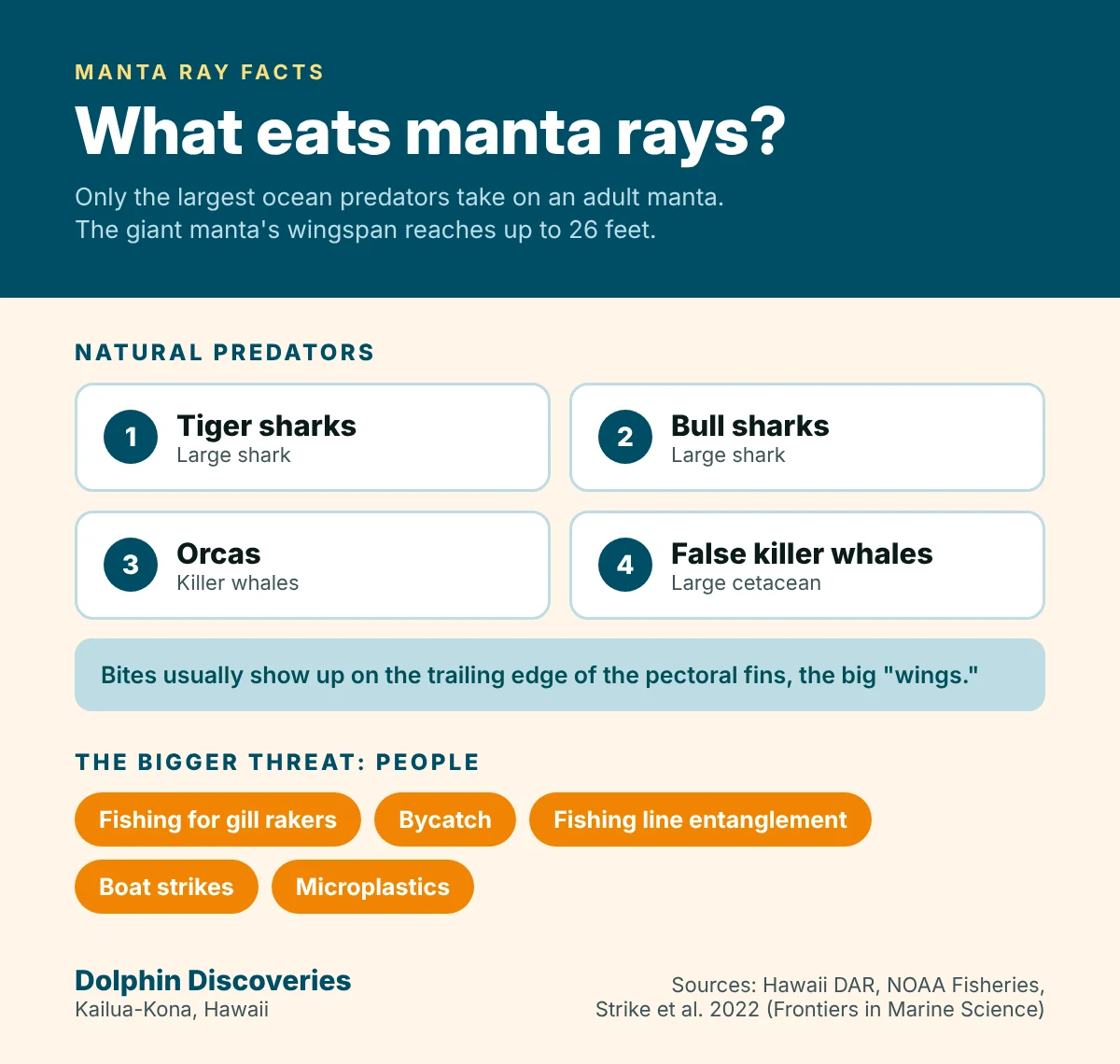
Adult manta rays have very few natural predators. Hawaii's Division of Aquatic Resources (DAR) says the only natural predators of oceanic manta rays are presumed to be large sharks and killer whales. That conclusion comes from photos of bite marks on living mantas.
A 2022 study of manta rays in the Maldives, published in Frontiers in Marine Science, names the large sharks and large cetaceans known to prey on adult mantas:
- Tiger sharks
- Bull sharks
- Orcas (killer whales)
- False killer whales
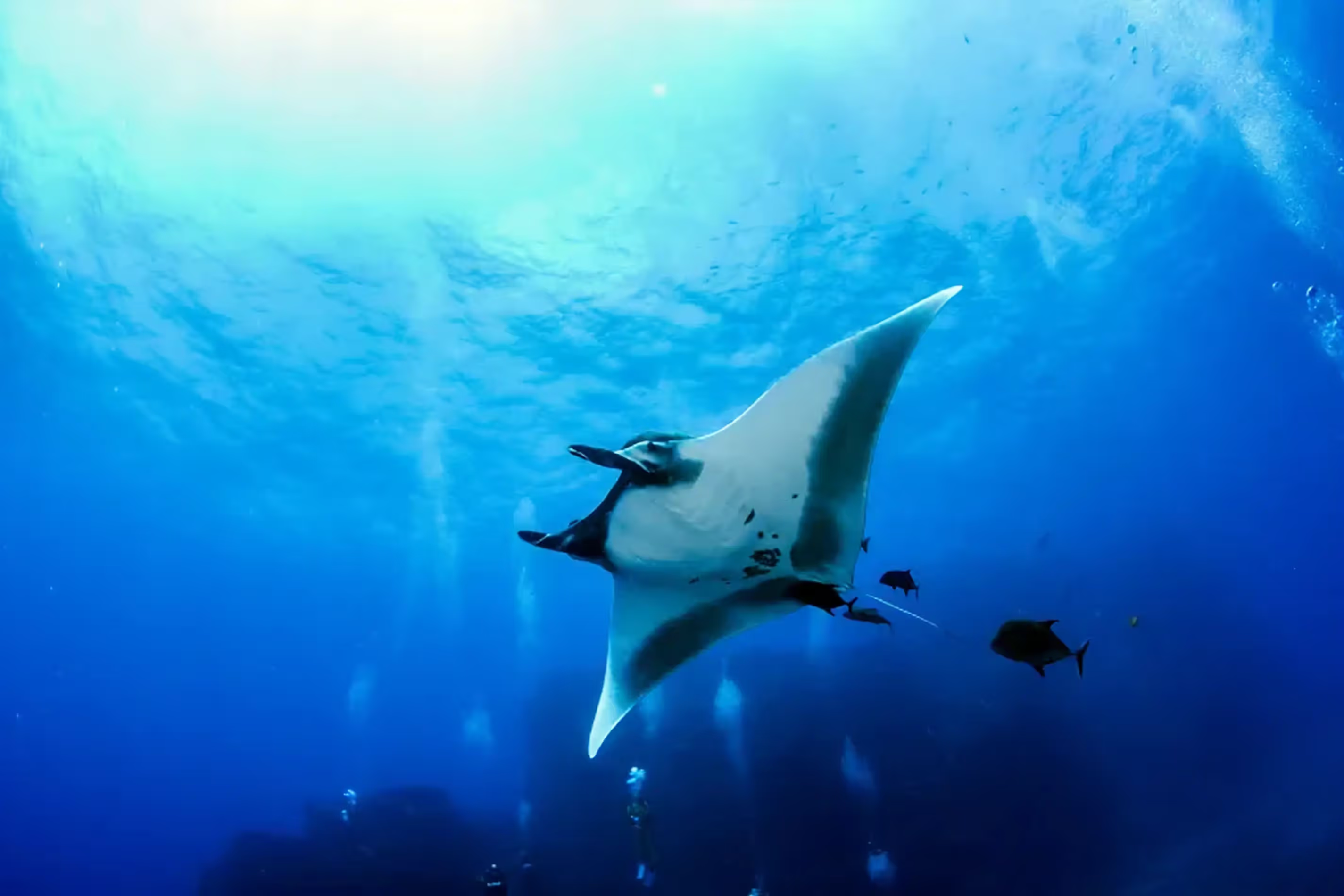
Size is a manta's best protection. NOAA Fisheries notes that the giant manta ray is the world's largest ray, with a wingspan of up to 26 feet. Not many animals in the sea are big enough to try.
Manta Ray Predators Leave Clues: What Bite Marks Show
Researchers almost never see an attack. They learn from the scars mantas carry. Each manta has its own pattern of spots on its belly, so scientists can photograph the same animal again and again and track new injuries over time.
In the Maldives study, predatory bites were the most common type of injury found on both reef and oceanic mantas. About 15% of the reef mantas studied there had bite marks. Bites usually show up on the trailing edge of the pectoral fins, the big "wings." Because these are scars on living animals, they show that many attacks fail.
Closer to home, the same paper points to a 2011 study from Maui, Hawaii, that found shark injuries on about a third of the mantas photographed there.
The Bigger Threat to Manta Rays: People
Sharks and orcas are part of a healthy ocean. Human threats are a different story. NOAA Fisheries calls overfishing for commercial purposes the most significant threat to the giant manta ray. DAR lists these threats for oceanic mantas:
- Fishing for gill rakers. The international fishing trade catches oceanic mantas for their gill rakers, the parts they use to filter food.
- Bycatch. Mantas are often caught by accident in fisheries targeting other fish.
- Fishing line entanglement. Their large bodies make them easy to tangle in gear and line.
- Boat strikes. Mantas can be injured when boats hit them.
- Microplastics. DAR also lists microplastics as a threat.
Fishing line is a real problem in Hawaii. The 2011 Maui study found that 10% of the reef mantas there had a missing or non-working cephalic fin, one of the two paddle-shaped fins beside the mouth. Monofilament fishing line was the likely cause.
Mantas are also slow to replace their numbers. According to NOAA, a manta typically gives birth to one pup every two to three years, after a pregnancy thought to last about a year. Every adult matters.
How Hawaii Protects Manta Rays
Hawaii state law (HRS §188-39.5) prohibits knowingly capturing, taking, possessing, abusing, entangling or killing any ray in state marine waters. DAR notes that this covers both reef and oceanic mantas. The oceanic manta is also listed as threatened under the federal Endangered Species Act, a listing made in 2018.
What This Means for the Mantas You See in Kona
The mantas that visit Manta Ray Village near Keauhou Bay come to feed. They are filter feeders that strain plankton from the water, and they are harmless to people. Lights draw plankton at night, and the mantas follow the food. You can read more on our Learn About Manta Rays page.
Our boats leave from Keauhou Bay, and the manta site is about a 5-minute ride away. On our manta ray night snorkel in Kona, you hold onto a lit float board at the surface. The tour is 2 hours total, with about 30 minutes in the water, for ages 6 to 70. It is $99.99. Mantas are wild animals, so what you see changes from night to night.
How to Help Manta Rays on Your Night Snorkel
You do not need to be a scientist to help. These five habits protect the mantas you meet.
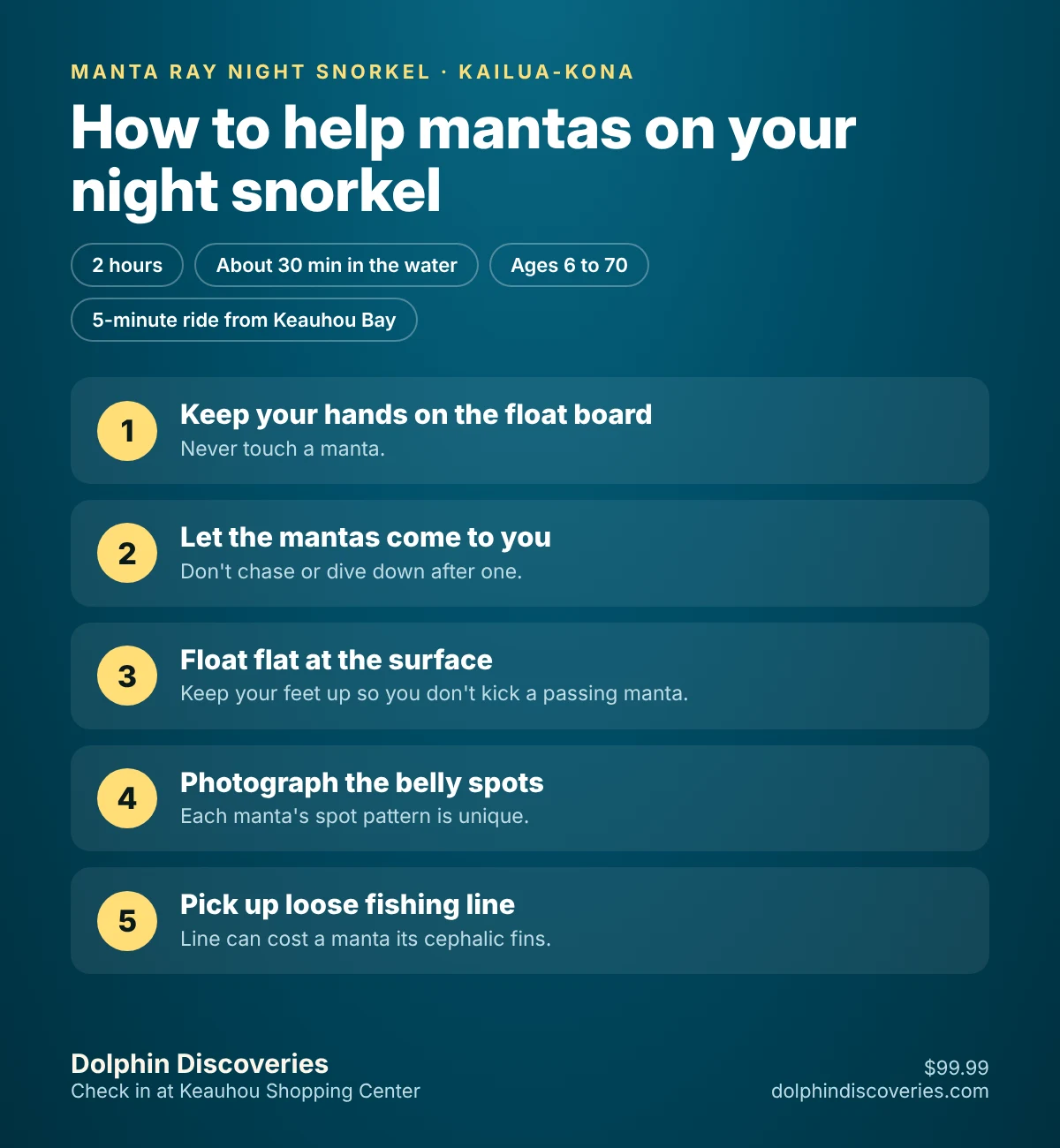
- Keep your hands on the float board. Never touch a manta. DAR asks everyone not to touch or chase them.
- Let the mantas come to you. Don't chase or dive down after one. They will pass close on their own.
- Float flat at the surface. Keep your feet up so you don't kick a passing manta.
- Photograph the belly spots. Each manta's spot pattern is unique. DAR asks people to photograph the underside of mantas they see.
- Pick up loose fishing line. When you find it on the beach or shoreline, bin it. Line can cost a manta its cephalic fins.
Before you go, check our Know Before You Go page for check-in details and a packing list, including reef-safe sunscreen. All tours check in at our store in the Keauhou Shopping Center, 78-6831 Ali'i Dr, Suite F-146, Kailua-Kona.
Planning more ocean time? See our guide to Kona water temperature by month, and if boats make you queasy, read how long seasickness lasts before you book. You can also browse all of our tours.
Manta Ray Predators FAQ
What eats manta rays?
Only very large predators. Researchers name tiger sharks, bull sharks, orcas and false killer whales as animals known to prey on adult mantas.
Do manta rays have predators in Hawaii?
Yes, but few. Hawaii's DAR says the only natural predators of oceanic mantas are presumed to be large sharks and killer whales. A 2011 Maui study found shark injuries on about a third of the mantas photographed there.
What is the biggest threat to manta rays?
People. NOAA Fisheries calls overfishing for commercial purposes the most significant threat to the giant manta ray. Bycatch, fishing line, boat strikes and microplastics also harm mantas.
Are manta rays dangerous to people?
No. Mantas are filter feeders that strain plankton from the water, and they are harmless to people.
Can I touch a manta ray in Hawaii?
Please don't. DAR asks people not to touch or chase mantas, and state law protects all rays in Hawaii's marine waters. On our tours, you keep your hands on the float board.
How long is the Manta Ray Night Snorkel?
It is 2 hours total, with about 30 minutes in the water, for ages 6 to 70. Have questions? Call us at (808) 322-8000 or read our FAQ.