


Manta rays are some of the biggest animals you can snorkel with in Kona. Yet they live on some of the smallest food in the sea. So what do manta rays eat? Mostly zooplankton: tiny drifting animals such as krill, copepods, mysid shrimp, and the larvae of crabs and shrimp. Some studies have found small fish in their diet too.
This guide covers the manta ray diet, how a manta filters its food through its gills, why mantas feed at night off the Kona coast, and what you can see when they feed under the lights on our night snorkel.
What Do Manta Rays Eat?
Manta rays are filter feeders. NOAA Fisheries says they "eat large quantities of zooplankton." Zooplankton are small animals that drift with the ocean currents. Here is what NOAA lists on the menu:
- Krill - small shrimp-like animals that scientists call euphausiids.
- Copepods - tiny crustaceans that drift in the water.
- Mysid shrimp - small shrimp-like animals.
- Crab and shrimp larvae - the young stages of decapods, the group that includes crabs and shrimp.
- Shrimp - small shrimp that drift with the plankton.
- Sometimes fish - NOAA notes that some studies found small and moderately sized fish in their diet as well.
Mantas are often solitary, but they gather where food is plentiful. The Hawaii Division of Aquatic Resources (DAR) says mantas aggregate around food resources, cleaning stations and mating trains.

Are Manta Rays Filter Feeders? How Manta Rays Eat
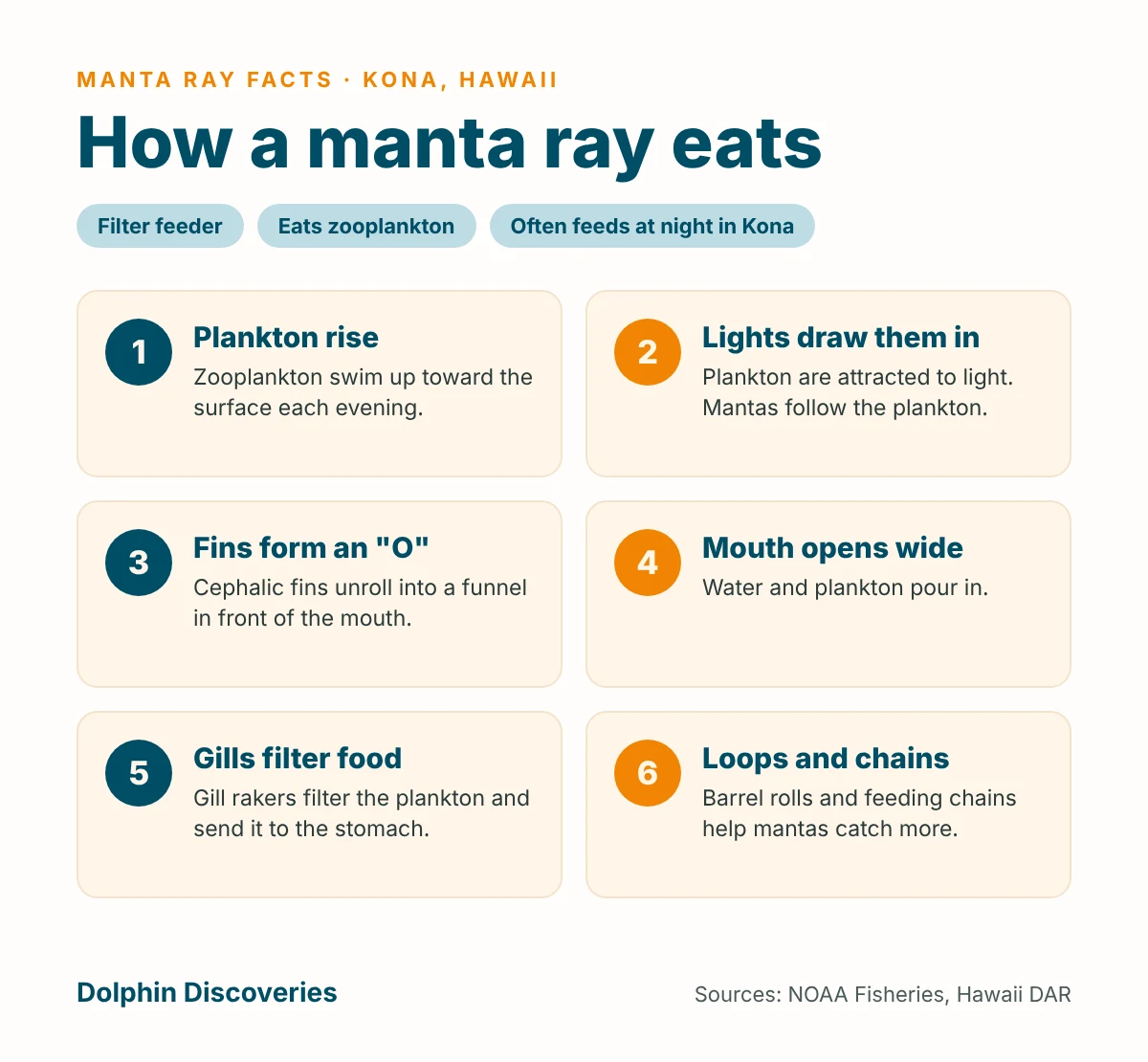
Yes. Instead of biting its food, a manta swims through a cloud of plankton with its mouth wide open and strains the food out of the water. Here is how it works, step by step:
- Plankton rise - Zooplankton swim up toward the surface each evening. DAR says they rise as far as 1,500 feet and return to the depths in the morning.
- Lights draw them in - The Manta Pacific Research Foundation, a Kona nonprofit, puts it simply: "Plankton are attracted to light, and mantas are attracted to plankton."
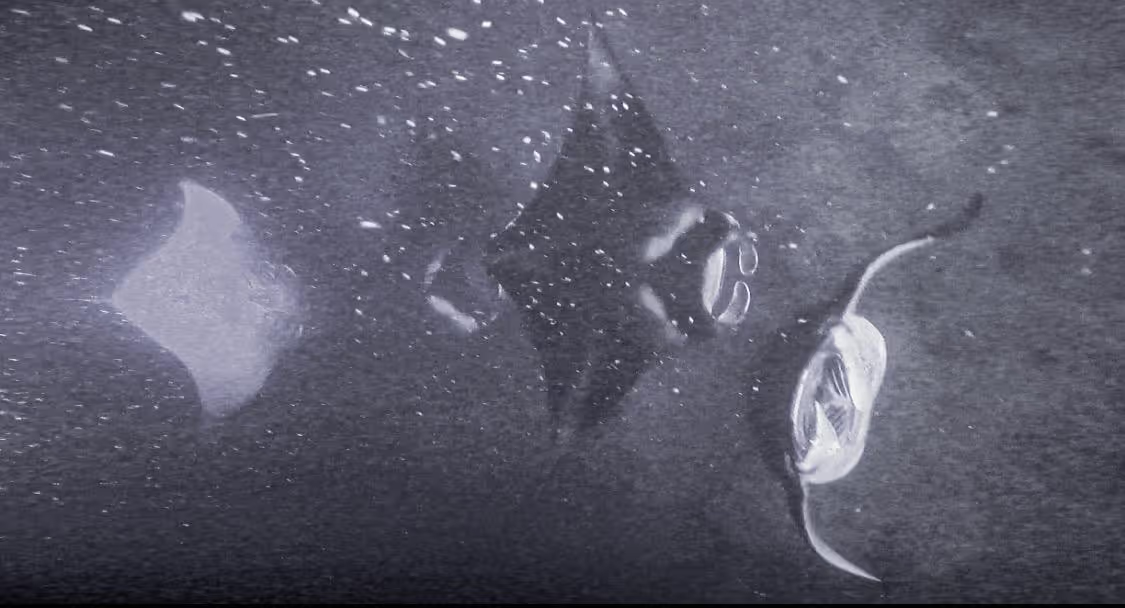
- Fins form an "O" - The two cephalic fins on the front of a manta's head unroll into a funnel. NOAA says mantas hold them in an "O" shape when feeding.
- Mouth opens wide - Water and plankton pour into the open mouth.
- Gills filter food - DAR says the water passes over the gill rakers, "which filter and divert the plankton into their stomach."
- Loops and chains - DAR says mantas are commonly seen barrel rolling and creating feeding chains with other mantas to catch more food.
What manta ray gills do
A manta's gills do two jobs. They take oxygen from the water, and they catch food. NOAA describes the feeding funnel pushing "water and prey through their mouth and over their gill plates."
Those gill plates work in a clever way. In 2018, researchers from Oregon State University and Cal State Fullerton described it in the journal Science Advances, as reported by ScienceDaily. The plates are lined with leaf-like lobes. As water flows past, food particles bounce off the lobes instead of sticking in the filter. The researchers called it "ricochet separation." It lets mantas keep food much smaller than the gaps in the filter, and the filter is very hard to clog.
Why Mantas Feed at Night Off Kona
The night snorkel works because of the manta's diet. Each evening, zooplankton rise from deep water toward the surface. When bright lights shine into the water, plankton gather in the beam. Mantas come in to eat them.
That is why our night snorkel uses lit float boards. You float above the light, the plankton gather below you, and any mantas that come in swim up through the beam to feed. You get a close view of the "O" funnel, the open mouth and the barrel rolls described above.
How Much Does a Manta Ray Eat?
There is no reliable number. NOAA says only that mantas eat "large quantities of zooplankton." You may see daily percentages quoted online, but none of the science sources we checked gives a figure, so we don't quote one here.
Why the Manta Diet Matters
Because mantas depend on tiny prey, changes in the ocean reach them fast. The Manta Trust says climate change is likely to affect the abundance of the zooplankton that reef mantas rely on. DAR adds that mantas can accidentally swallow microplastics and can lose prey to ocean acidification.
Their feeding gear is also a target. NOAA and DAR both say mantas are fished for their gill plates, which are traded internationally. To learn more about the risks mantas face, read what eats manta rays. To see how big these filter feeders get, read our guide to manta ray size. Our Learn About Manta Rays page has more background.
Watch Mantas Feed on Our Night Snorkel
On our manta ray night snorkel in Kona, you see feeding up close. Here is what to expect:
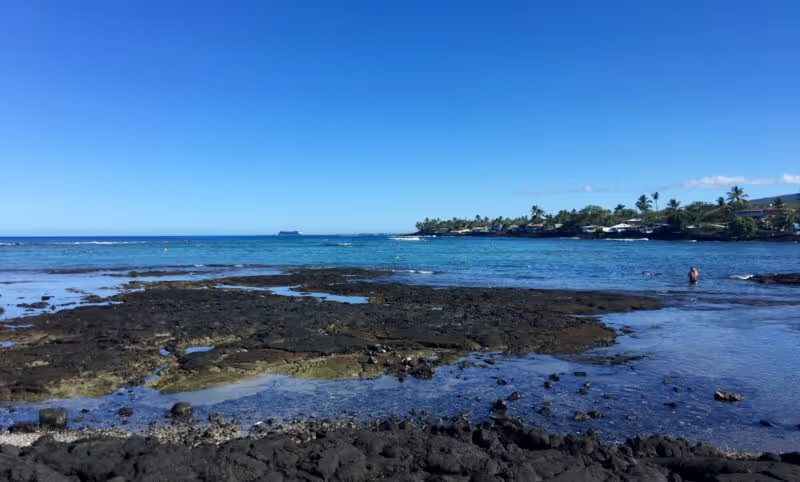
- Check in - Meet us at our store in the Keauhou Shopping Center, 78-6831 Ali'i Dr, Suite F-146, Kailua-Kona.
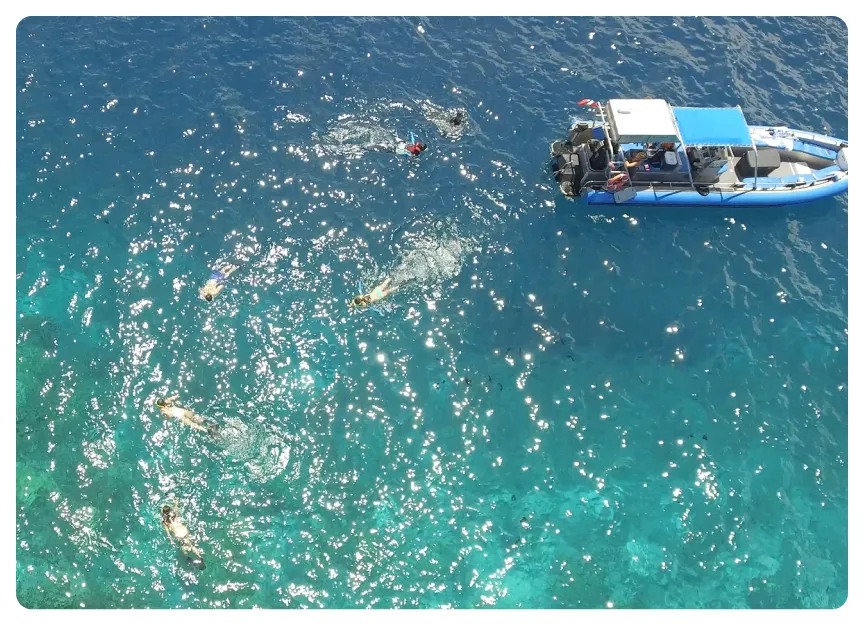
- Short boat ride - We leave Keauhou Bay on a small-group rigid-hull inflatable boat. The manta site is about 5 minutes away.
- Hold the light board - You swim a short way to a lit float board, lie flat and hold on. Pool noodles help keep you level. The water is about 35 to 40 feet deep.
- Watch for feeding - If mantas come in, they swim up through the light with their mouths open, then loop and turn below you.
- Back to the boat - You spend about 30 minutes in the water. The whole tour is 2 hours.
Mantas are wild animals, so sightings are never guaranteed. Please don't touch or chase them. Hawaii law (HRS §188-39.5) protects all rays in state marine waters. Keep your hands on the board and let the mantas come to you. Before you go, check our Know Before You Go page for what to bring.
Manta Ray Diet FAQ
What do manta rays eat?
Mostly zooplankton. NOAA Fisheries lists krill (euphausiids), copepods, mysids, crab and shrimp larvae, and shrimp. Some studies have also found small and moderately sized fish.
Are manta rays filter feeders?
Yes. Mantas swim with their mouths open and strain plankton from the water with their gill rakers, also called gill plates.
Do manta rays eat fish?
Sometimes. Plankton make up most of the diet, but NOAA notes that some studies found small and moderately sized fish too.
Why do manta rays come to the lights?
To eat. Plankton are attracted to light, and mantas are attracted to plankton. The lights on our float boards gather plankton, and mantas come in to feed on it.
Are manta rays dangerous to snorkelers?
Mantas eat tiny zooplankton, not people. On our tour you float at the surface and the mantas swim below. Keep your hands to yourself and follow your crew's instructions.
How long is the Manta Ray Night Snorkel?
It is 2 hours total, with about 30 minutes in the water, for ages 6 to 70. The price is $99.99. You need to know how to swim to get in the water. Have questions? Call us at (808) 322-8000 or read our FAQ.