


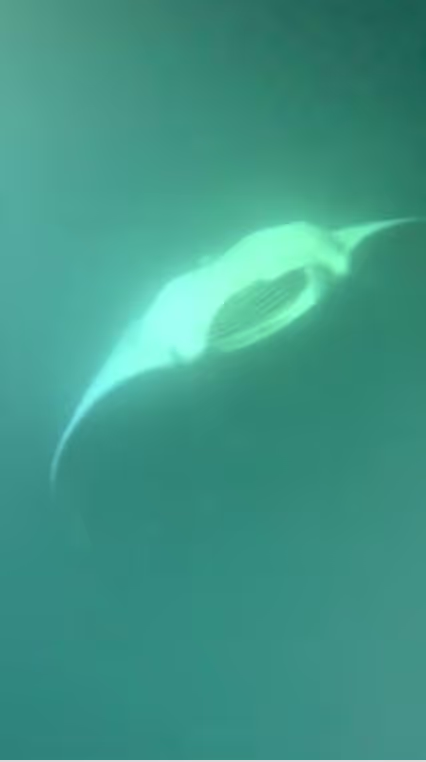
Manta rays look huge when they glide up through the lights on a night snorkel. So how big are manta rays, really? It depends on the species. The reef mantas you meet off Kona average about 10 to 11.5 feet from wingtip to wingtip. Their cousin, the giant oceanic manta, can reach 26 feet across, which makes it the largest ray in the world.
This guide covers manta ray size for both species, how heavy they get, how researchers measure the mantas that live off the Kona coast, and how to tell the two species apart. It also covers what that size looks like from the surface when you float above mantas with us at night.
Manta Ray Size at a Glance
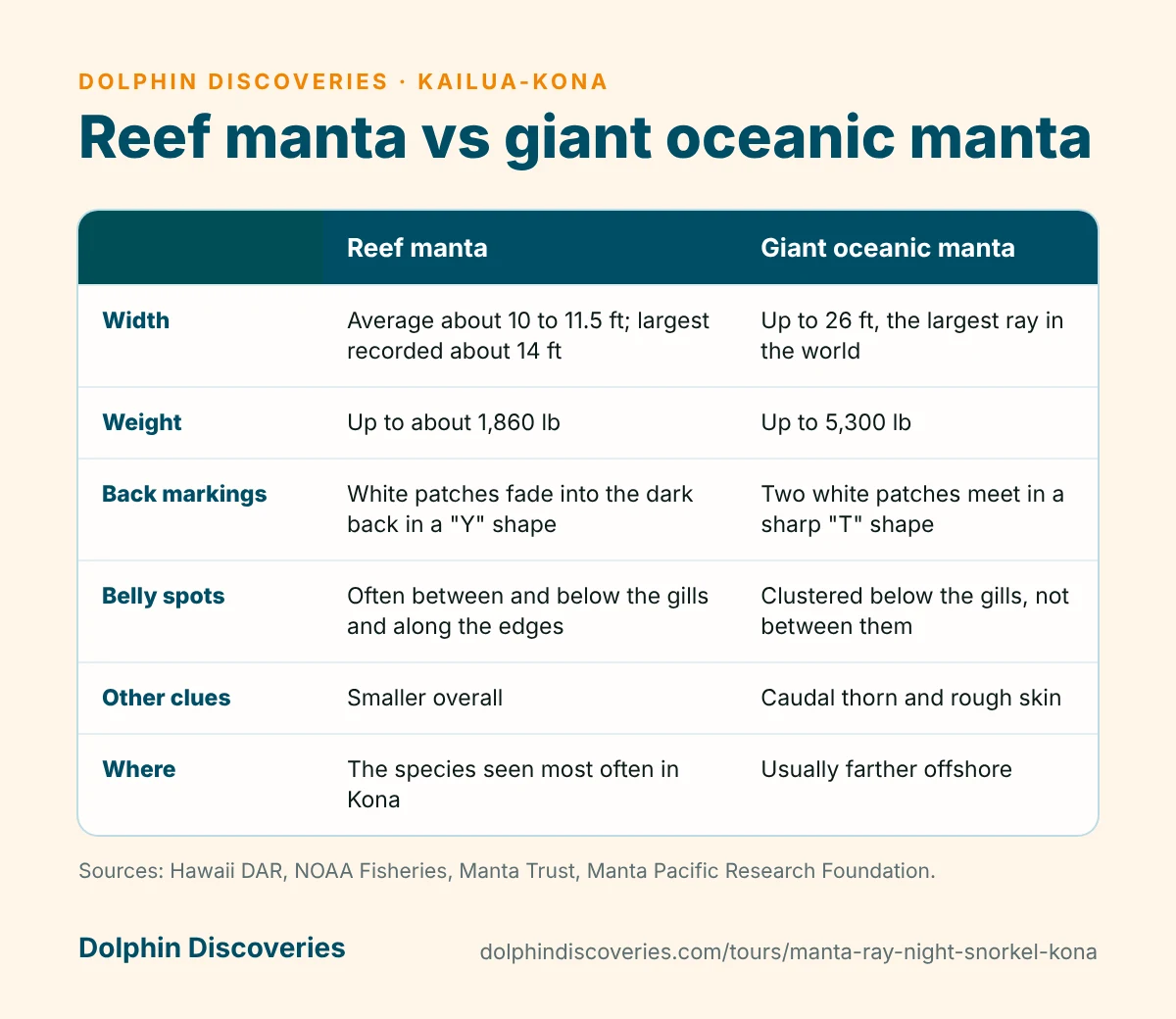
Two manta species live in Hawaii's waters. The Hawaii Division of Aquatic Resources (DAR) notes that state law protects both the giant oceanic manta and the reef manta. Here is how their size compares. We converted metric figures to feet and pounds and rounded them.
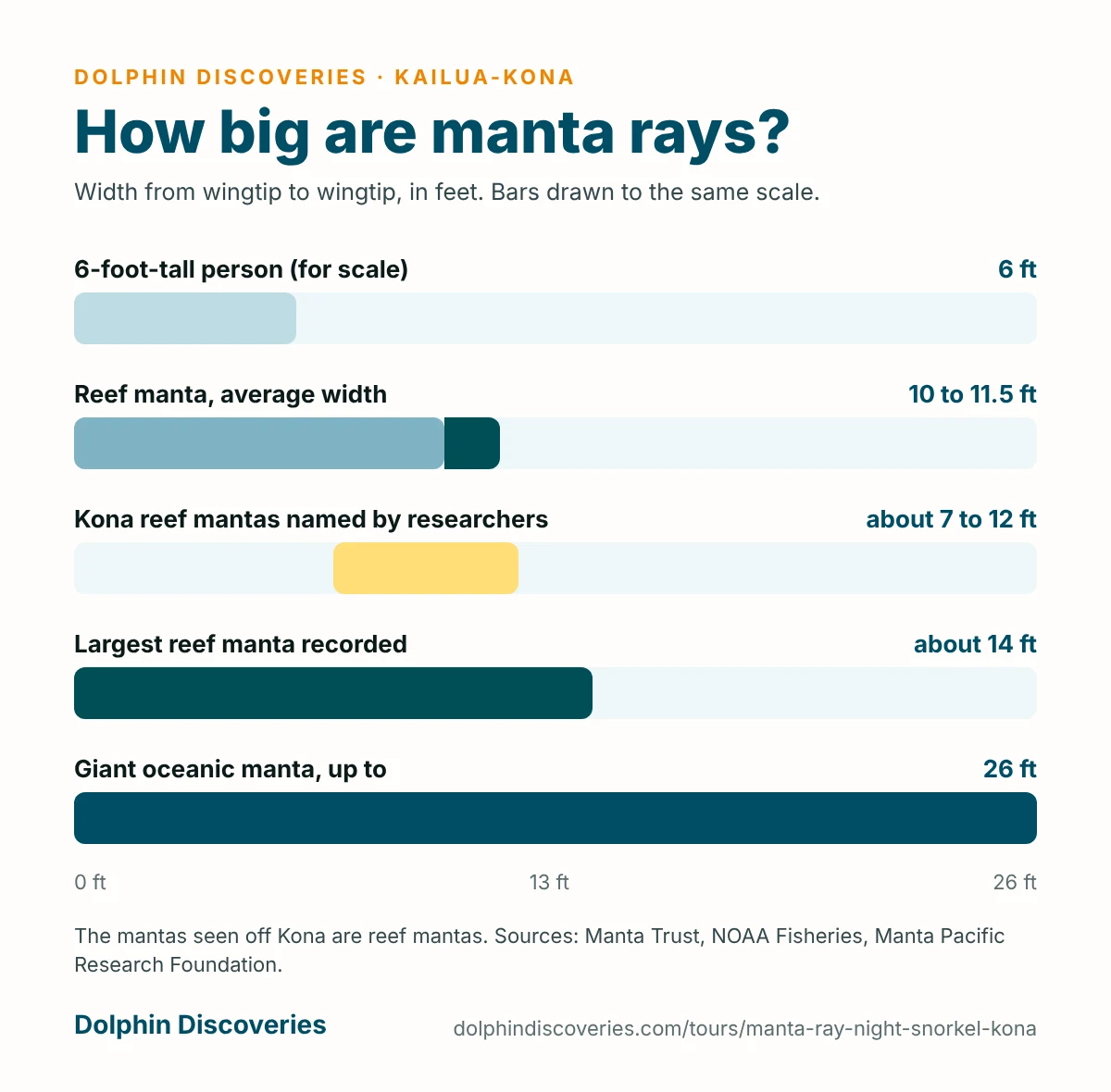
- Reef manta, average width - about 10 to 11.5 feet (300 to 350 cm), according to the Manta Trust.
- Reef manta, largest recorded width - about 14 feet (431 cm), also from the Manta Trust.
- Reef manta, heaviest - about 1,860 pounds (roughly 844 kg).
- Giant oceanic manta, width - up to 26 feet, according to NOAA Fisheries.
- Giant oceanic manta, weight - up to 5,300 pounds (NOAA Fisheries).
To picture it, an average reef manta is about twice as wide as a 5-foot-tall person is tall. A 26-foot giant manta is wider than four 6-foot-tall people lying head to toe.
How Big Are the Manta Rays in Kona?
The mantas you see on a Kona night snorkel are usually reef mantas. The Manta Pacific Research Foundation, a Kona nonprofit, says the reef manta is the species seen most commonly in Kona. The foundation has identified and named over 300 individual mantas near Kona.
Many of those mantas have known sizes. Here are a few from the foundation's Meet the Mantas page:
- Big Bertha - about 11.7 feet across, one of the largest mantas in the Kona group.
- Lefty - a wingspan of about 12 feet.
- Sugar Ray - about 9.8 feet across.
- Hip Hip HooRay - an 8-foot-wide male.
- Blain Ray - about 7 feet from wingtip to wingtip.
So a manta passing under you in Kona could be anywhere from about 7 to 12 feet wide. Some of these mantas have been seen off the Kona coast for decades.
How researchers know a manta's size
Each manta has its own pattern of dark spots on its white belly. DAR asks anyone who sees a manta to photograph the underside, because those spots work like a fingerprint. Once a manta is known by its spots, researchers can follow it year after year. The foundation describes several of Kona's mantas as "calculated" to be a certain width, so treat these as careful estimates, not tape-measure readings.
Reef Manta vs Giant Oceanic Manta: How to Tell Them Apart
Size is hard to judge in the water, so these clues help:
- Back markings - DAR says the giant oceanic manta has two white patches on its back that meet in a sharp "T" shape. On a reef manta, the patches fade into the dark back and form more of a "Y" shape.
- Belly spots - Giant mantas have dark spots clustered below the gills but not between them. Reef mantas often have spots between and below the gills and along the edges of the belly (DAR).
- Skin and tail - NOAA Fisheries says giant mantas are generally larger than reef mantas, have a caudal thorn, and have a rough skin appearance.
- Where they live - DAR notes that oceanic mantas are usually found farther offshore than reef mantas.
How Long Do Manta Rays Live?
Nobody knows for sure. NOAA Fisheries says manta rays have been reported to live at least 45 years. The Manta Trust says reef mantas likely live around 40 years. Mantas also mature slowly. The Manta Pacific Research Foundation says male mantas reach maturity around 6 to 9 years old and females at 10 to 12 years old. NOAA adds that a giant manta has one pup every 2 to 3 years, which is why careful, low-impact viewing matters so much.
Curious about other manta facts? Read how fast manta rays swim or learn what eats manta rays. Our Learn About Manta Rays page has more background.
What Manta Size Looks Like on Our Night Snorkel
On our manta ray night snorkel in Kona, you see these animals from just a few feet above. Here is how the evening works:
- Check in - Meet us at our store in the Keauhou Shopping Center, 78-6831 Ali'i Dr, Suite F-146, Kailua-Kona.
- Short boat ride - We leave Keauhou Bay on a small-group rigid-hull inflatable boat. The manta site is about 5 minutes away.
- Hold the light board - You swim a short way to a lit float board, lie flat and hold on. Pool noodles help keep you level. The water is about 35 to 40 feet deep.
- Watch them feed - If mantas come in, they swim up through the light to feed and turn below you. A manta that is 10 feet across can pass just below the board.
- Back to the boat - You spend about 30 minutes in the water. The whole tour is 2 hours.
Mantas are wild animals, so sightings are never guaranteed. Please don't touch or chase them. Hawaii law (HRS §188-39.5) protects all rays in state marine waters. Keep your hands on the board and let the mantas come to you.
Before you go, check our Know Before You Go page for what to bring.
Manta Ray Size FAQ
How big are manta rays?
Reef mantas average about 10 to 11.5 feet wide, and the largest recorded was about 14 feet. Giant oceanic mantas can reach 26 feet across and weigh up to 5,300 pounds.
How big are the manta rays in Kona?
Kona's mantas are mostly reef mantas. Named individuals tracked by the Manta Pacific Research Foundation range from about 7 feet to about 12 feet across.
What is the largest manta ray?
The giant oceanic manta is the largest ray in the world, with a wingspan of up to 26 feet, according to NOAA Fisheries.
How much does a manta ray weigh?
The Manta Trust lists a top weight of about 1,860 pounds for reef mantas. NOAA Fisheries says giant oceanic mantas can weigh up to 5,300 pounds.
Are big manta rays dangerous to snorkelers?
Mantas are filter feeders that eat tiny zooplankton. On our tour you float at the surface and the mantas swim below. Keep your hands to yourself and follow your crew's instructions.
How long is the Manta Ray Night Snorkel?
It is 2 hours total, with about 30 minutes in the water, for ages 6 to 70. The price is $99.99. You need to know how to swim to get in the water. Have questions? Call us at (808) 322-8000 or read our FAQ.