

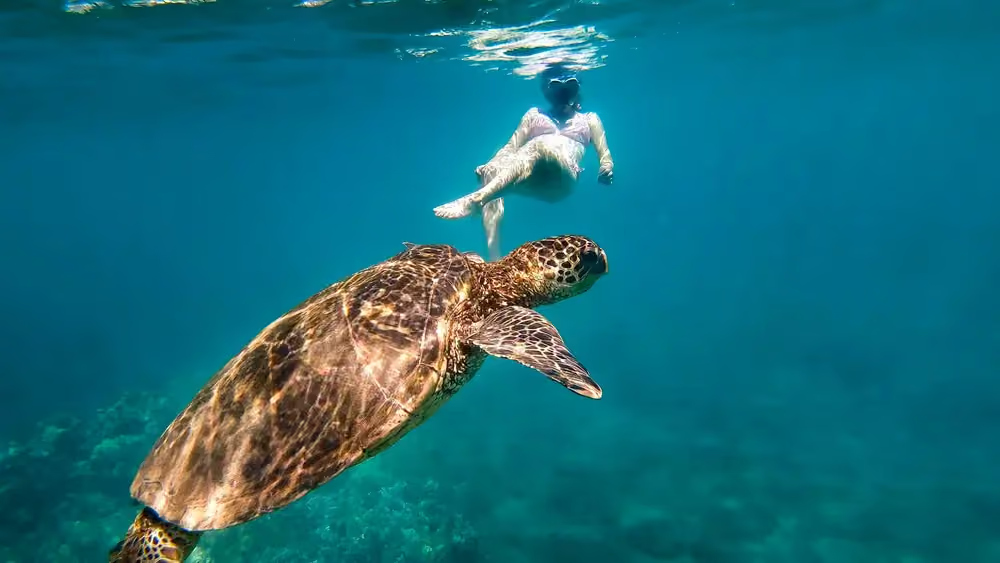
Few things stop a snorkeler like a sea turtle gliding past the reef. If you are planning a trip to the Big Island, you probably want to know which sea turtles live in Hawaii, where you might see one, and how close you can get. This guide covers the basics, the rules, and how a snorkel trip with us fits in.
One promise up front: turtles are wild animals. We can take you to reefs where honu are often seen, but no one can guarantee a sighting.
Types of Sea Turtles in Hawaii
NOAA Fisheries lists five species of sea turtles in the Pacific Islands region: green, hawksbill, loggerhead, olive ridley and leatherback. Near shore in Hawaii, two names come up again and again.
Green sea turtle (honu)
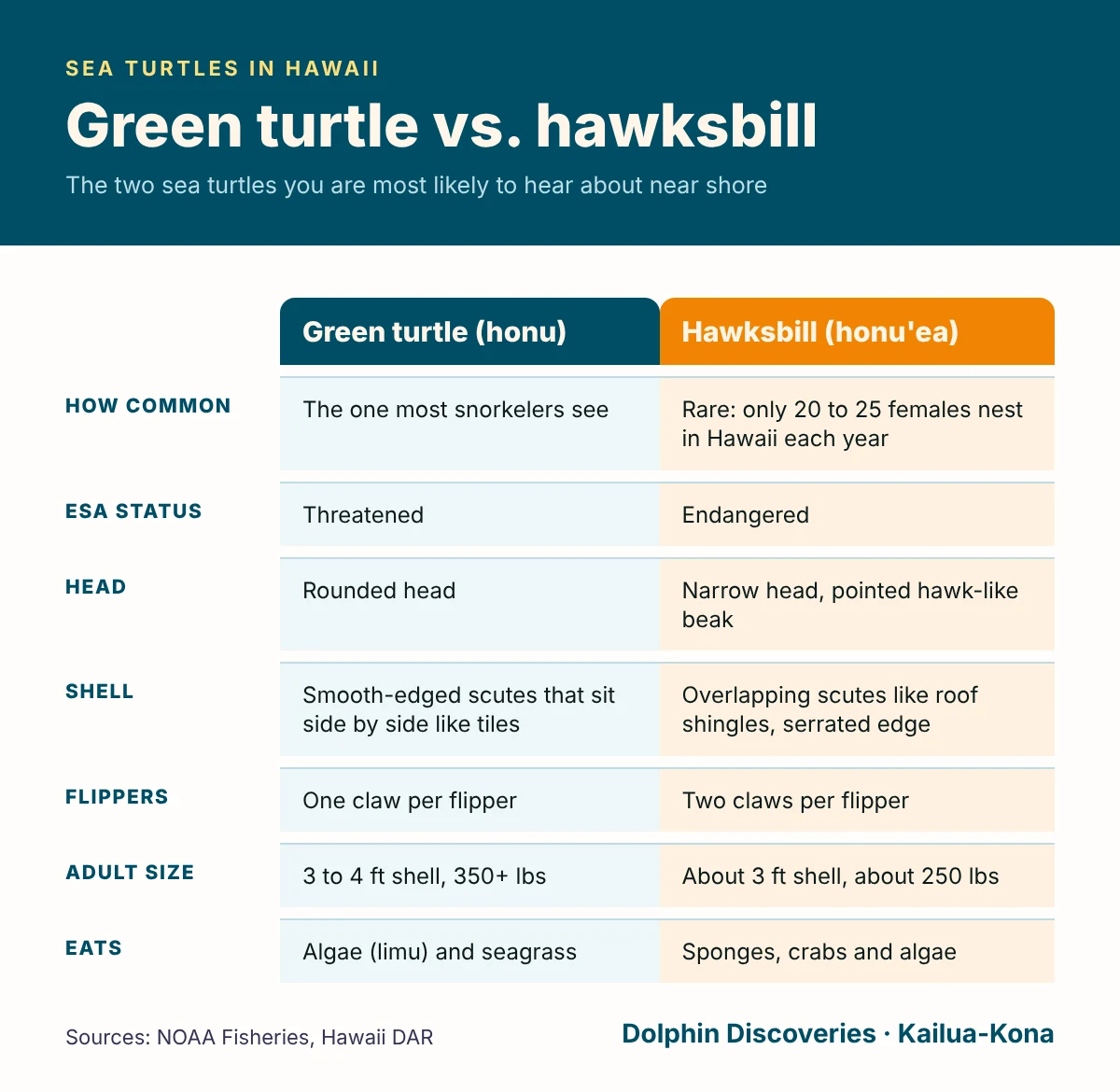
The Hawaiian green sea turtle, or honu, is the turtle most snorkelers meet. According to Hawaii's Division of Aquatic Resources (DAR), adults measure 3 to 4 feet long and can weigh over 350 pounds. They eat mostly algae (limu) and seagrass, which is why you often find them grazing on nearshore reefs.
A few more honu facts from DAR and NOAA:
- Status: Hawaiian green turtles are listed as threatened under the federal Endangered Species Act.
- Nesting: About 96% of the Hawaiian population nests at Lalo (French Frigate Shoals) in the Northwestern Hawaiian Islands.
- Slow to grow up: They reach maturity between 25 and 35 years of age.
- Beach naps: Green turtles are the only sea turtles in Hawaii that bask on the beach.
Hawksbill (honu'ea)
The hawksbill is far rarer. NOAA's hawksbill guide says only 20 to 25 hawksbill females nest in Hawaii each year, and the species is listed as endangered. Its main nesting beaches are on the south Ka'u coast of Hawaii Island, south Maui and eastern Molokai. Adults reach about 3 feet in shell length and around 250 pounds, and they eat mostly sponges, crabs and algae.
How to Tell a Green Turtle From a Hawksbill
You can usually tell them apart in a few seconds. NOAA points to three clues:
- Head: A green turtle has a rounded head. A hawksbill has a narrow head and a pointed, hawk-like beak.
- Shell: A green turtle's scutes (shell plates) have smooth edges and sit side by side like tiles. A hawksbill's scutes overlap like roof shingles, with a serrated edge.
- Flippers: Green turtles have one claw on each flipper. Hawksbills have two.
If you think you saw a hawksbill, snap a photo from a respectful distance and tell our crew. NOAA asks people to report hawksbill sightings.
Where to See Sea Turtles on the Big Island
On the Kona side, the reefs we snorkel are good places to watch for honu.
- Kealakekua Bay: Our Captain Cook snorkel tour visits the reef near Captain Cook Monument, known for tropical fish and Hawaiian sea turtles. It runs 3.5 hours including check-in, costs $99.99, and is for ages 6 to 70.
- A gentler start: The Morning Captain Cook Snorkel Adventure goes to the same bay at a slower pace that suits new snorkelers. It is also 3.5 hours including check-in, $99.99, ages 6 to 70.
- Two reefs in one trip: The Kona snorkel tours option with two stops pairs Kealakekua Bay with Honaunau Bay beside the Place of Refuge. It is 5 hours total (4 hours on the water), $119.99, ages 6 to 70.
- Staying dry: On Dolphin and Whale Watching Kailua-Kona, guests sometimes spot honu from the boat. There is no swimming, and it is 2.5 hours with check-in time built into the schedule, for ages 5 to 70.
Want your own boat? The Kona Private Boat Tour is 4 hours, customizable, for up to 28 guests. You can book it on our website.
Can You Touch Sea Turtles in Hawaii?
No. Sea turtles are protected by both federal and state law. The Hawaii Department of Land and Natural Resources (DLNR) says feeding or touching turtles in any way counts as a disturbance and is illegal. The state rules are Hawaii Revised Statutes Chapter 195D and Hawaii Administrative Rules 13-124.
What to Expect if a Turtle Swims By
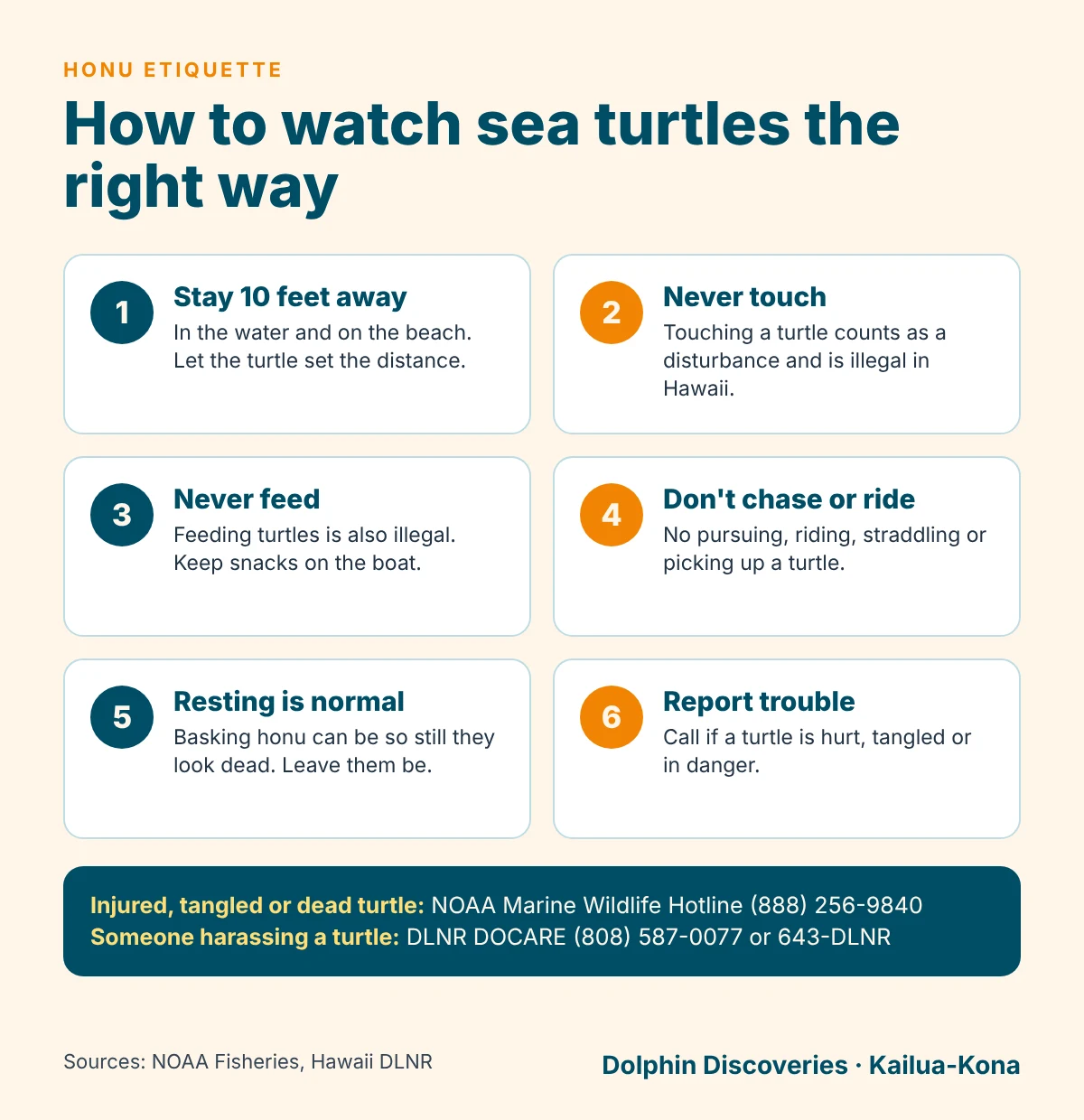
Here is how to handle a turtle encounter, step by step:
- Stay 10 feet away. NOAA asks people to stay at least 10 feet (3 meters) from sea turtles, in the water and on the beach.
- Never touch. Touching is a disturbance under state rules.
- Never feed. Feeding turtles is also illegal.
- Don't chase or ride. DLNR asks people not to pick up, restrain, jump over, straddle, pursue or ride turtles.
- Let resting turtles rest. NOAA notes that basking honu can be so still they look dead. They are usually just resting.
- Report trouble. For an injured, tangled or dead turtle, call the NOAA Marine Wildlife Hotline at (888) 256-9840. To report someone harassing a turtle, call DLNR DOCARE at (808) 587-0077 or 643-DLNR.
Our crew will point out marine life and help you keep a respectful distance. For more trip prep, read our Know Before You Go page, and check our guide to Kona water temperature so you know what to pack.
Sea Turtles in Hawaii FAQ
What kinds of sea turtles are in Hawaii?
NOAA lists five species in the Pacific Islands region: green, hawksbill, loggerhead, olive ridley and leatherback. Near shore, the green sea turtle (honu) is the one most people see. The hawksbill (honu'ea) is rare.
Is it illegal to touch sea turtles in Hawaii?
Yes. DLNR says feeding or touching turtles in any way is a disturbance and illegal under state and federal law.
How close can you get to sea turtles in Hawaii?
NOAA asks you to stay at least 10 feet (3 meters) away.
What do sea turtles in Hawaii eat?
Green turtles eat mostly algae (limu) and seagrass. Hawksbills eat mostly sponges, crabs and algae.
Will I see a sea turtle on a Dolphin Discoveries snorkel tour?
We can't promise it, because turtles are wild. Kealakekua Bay is known for Hawaiian sea turtles, and our crew will point them out when they show up. Questions? Call (808) 322-8000 or see our FAQ.