

One of the World's Best Wildlife Encounters Is Waiting Just Off the Big Island
Kona, Hawaii manta ray night snorkeling is widely regarded as one of the most reliable and accessible wildlife encounters on the planet. Every evening, giant reef manta rays glide up from the depths to feed on plankton drawn by underwater lights — and you can float right above them.
Here is a quick overview of what you need to know:
| Topic | Quick Answer |
|---|---|
| Best location | Keauhou Bay / Manta Village, Kona Coast |
| Best time to go | Year-round; sighting success rate is over 90% |
| Experience types | Snorkeling (surface) or scuba diving |
| Tour timing options | Sunset departure or after-dark |
| Average in-water time | 40–45 minutes |
| Are manta rays dangerous? | No — no teeth, stingers, or barbs |
| Typical cost | $99–$210 depending on operator and tour type |
| Manta guarantee? | Most reputable operators offer free rebooking |
Kona is home to roughly 130 resident reef manta rays that return to the same feeding sites night after night. An estimated 80,000 people come to Hawaiʻi each year just to swim with them. It's a bucket-list experience that consistently delivers — which is rare for any wildlife encounter.
But not all tours are equal. Group size, boat speed, light power, departure timing, and operator ethics all shape how good your experience actually is.
This guide compares your main options so you can choose the right tour for your trip.
Why Kona is the Ultimate Destination for a Kona Hawaii Manta Ray Encounter
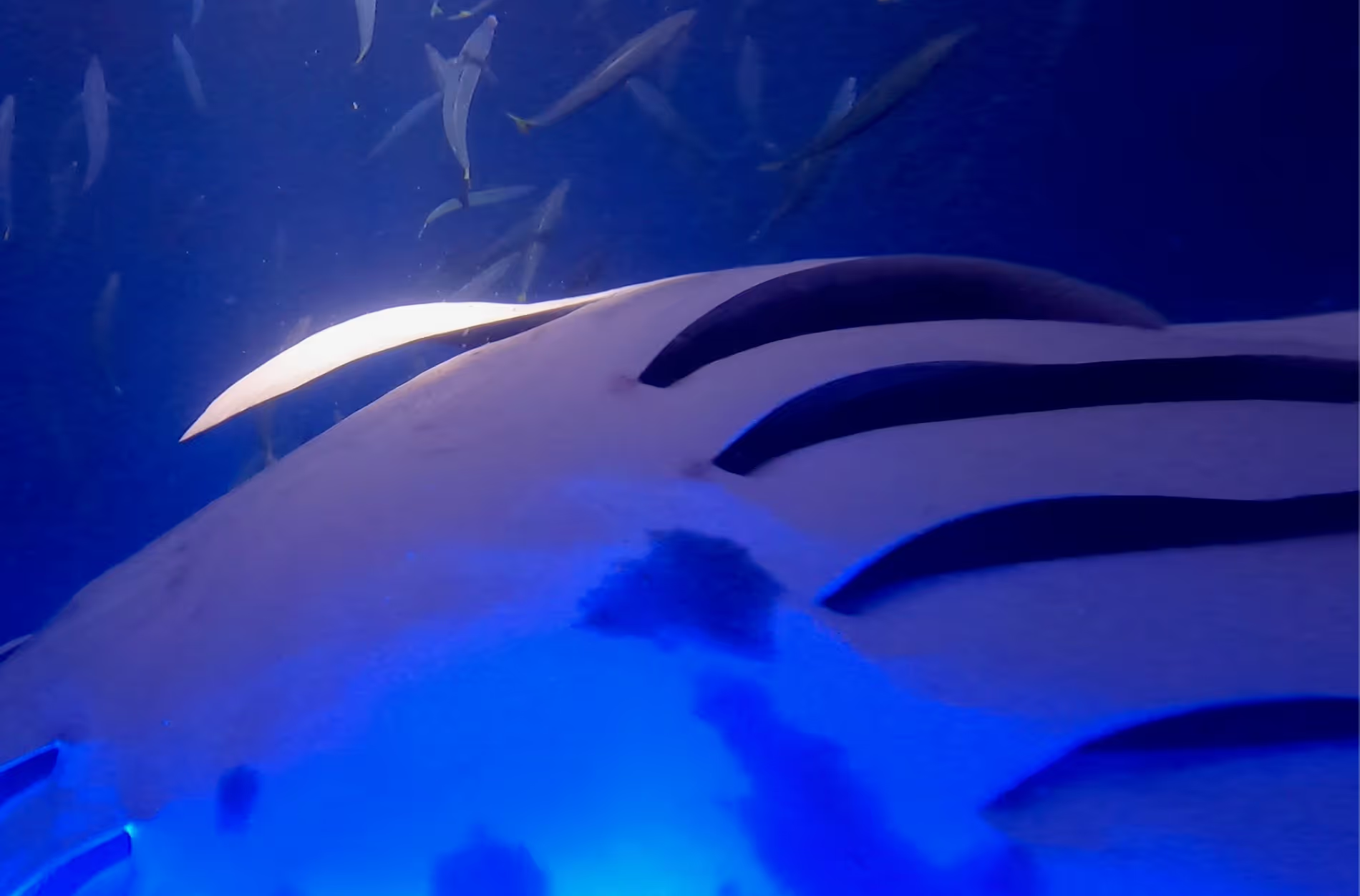
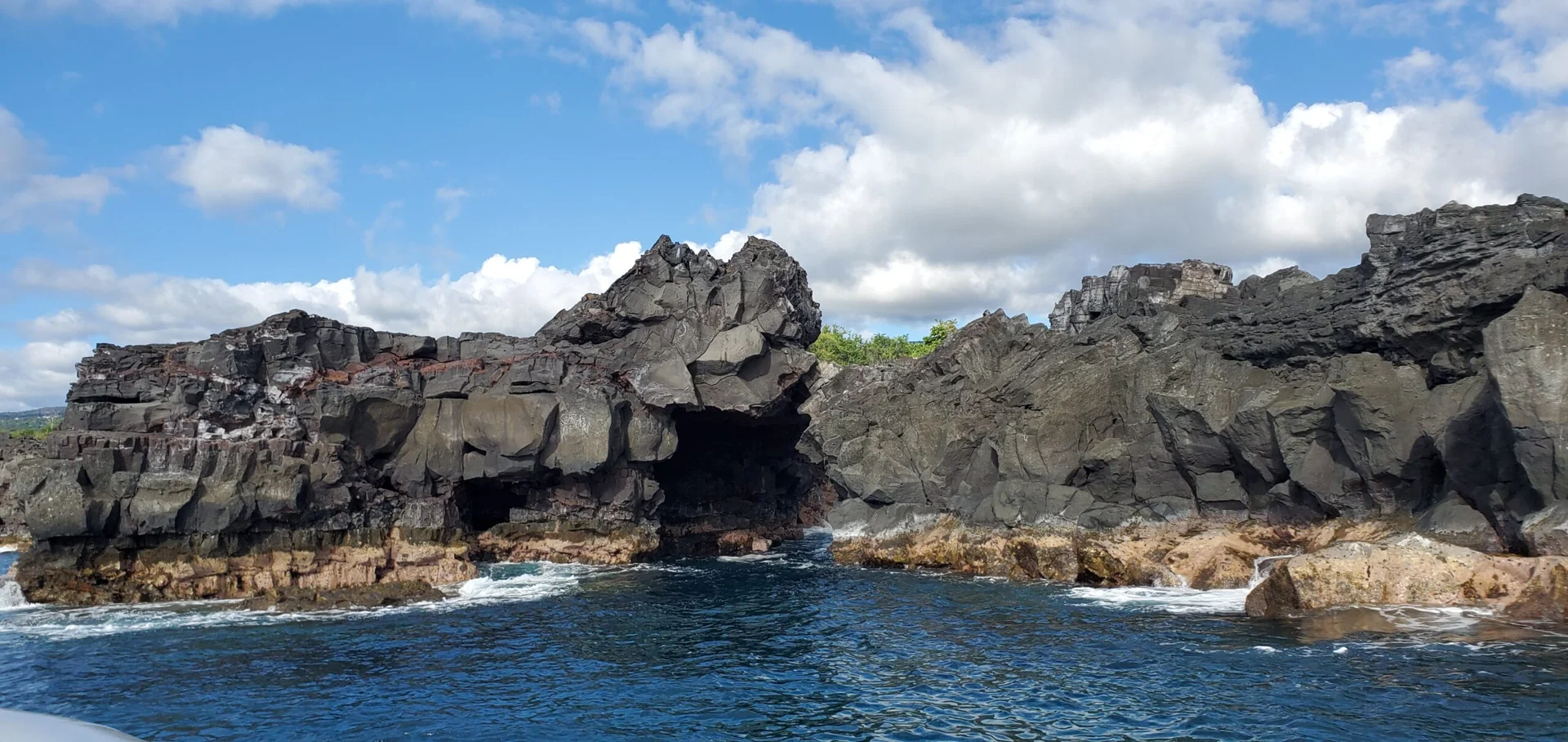
The volcanic underwater topography of the Big Island of Hawaii plays a massive role in creating this world-class phenomenon. Kona's coastline drops off rapidly into deep, nutrient-rich ocean waters. Strong coastal currents push these deep waters upward against the steep volcanic slopes, creating natural upwelling zones.
These upwellings are packed with microscopic marine life, particularly phytoplankton. In the natural order of the ocean, where phytoplankton gathers, zooplankton follows. And where zooplankton swarms, the ocean's most elegant filter feeders-manta rays-arrive for a feast.
While other global manta hotspots like Ecuador host massive migratory populations of giant oceanic manta rays (estimated at over 22,000 individuals), Hawaii's magic lies in its consistency. The resident population of about 130 manta rays along the Kona Coast does not migrate across the open ocean. They remain in these warm, coastal waters year-round, making sightings incredibly predictable.
This unique behavioral pattern took a fascinating turn in 1979. A coastal resort built along Keauhou Bay turned on bright floodlights pointing at the surf to showcase the crashing waves for dinner guests. Unintentionally, the resort created the ultimate "plankton dinner bell."
The bright lights attracted dense clouds of zooplankton, and a few local reef manta rays quickly discovered this concentrated, effortless buffet. Over the decades, through classical conditioning, more and more resident mantas learned to associate artificial light sources with an easy meal. Today, this learned behavior forms the foundation of the famous Kona night snorkel.
The Science Behind the Kona Hawaii Manta Ray Phenomenon
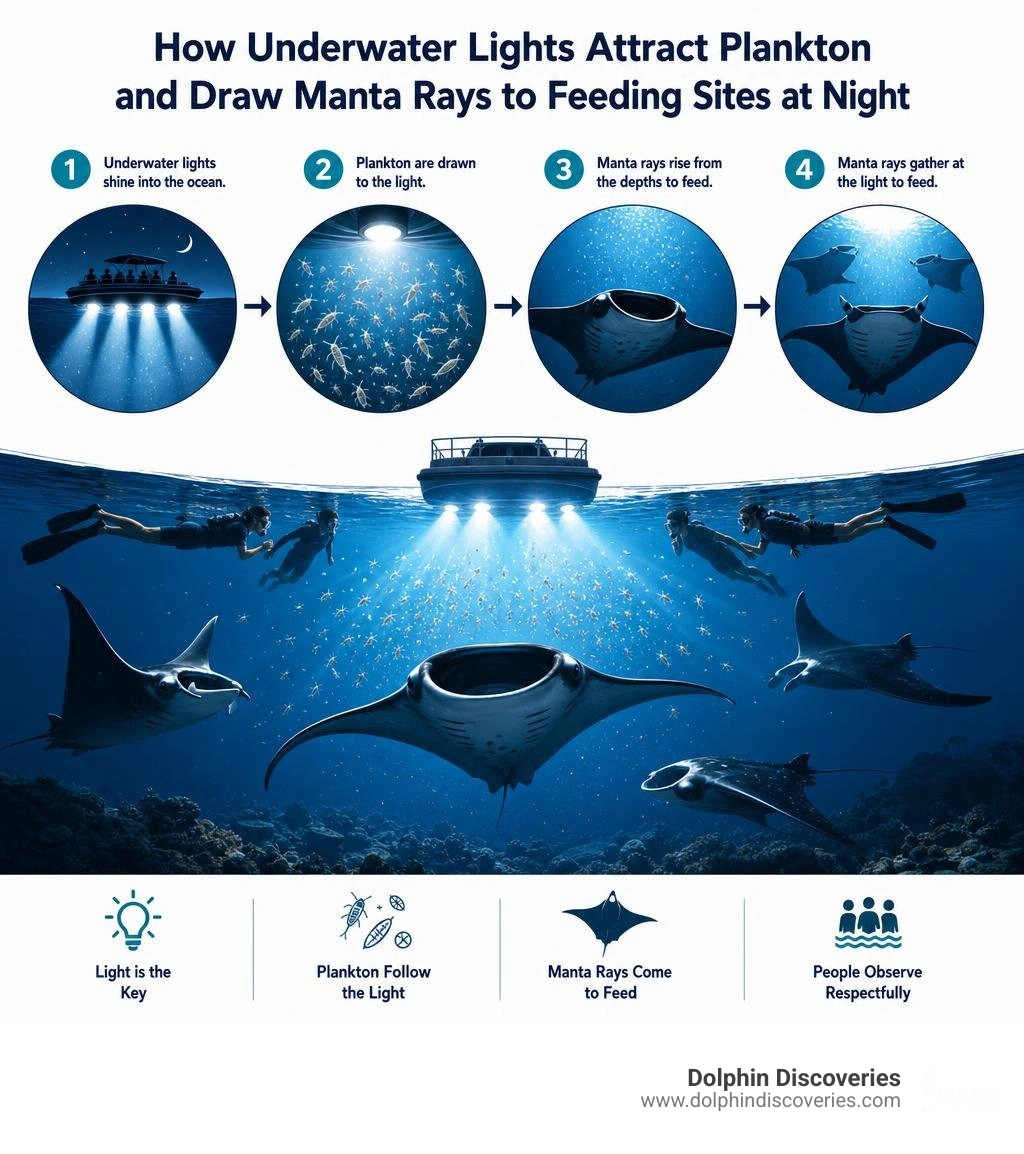
To truly appreciate this experience, it helps to understand the biological partnership between the lights, the plankton, and the rays. Plankton consists of tiny, drifting plants and animals that form the base of the marine food web. Many of these organisms exhibit phototaxis, meaning they are naturally attracted to light.
When tour operators deploy custom-built floating rafts equipped with high-powered LED light boards-often generating between 150,000 and 200,000 lumens of light-they mimic natural bioluminescent triggers. Within minutes, a thick, swirling cloud of zooplankton gathers around the lights.
For the manta rays, this is an irresistible invitation. Possessing the largest brain-to-body ratio of any fish species, mantas are highly intelligent and capable of complex learning. They quickly navigate to the light sources and begin performing what guides call the "manta ballet."
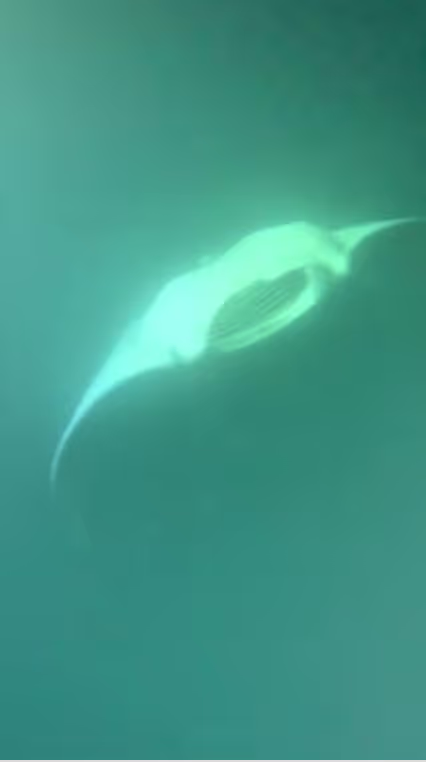
To maximize their food intake, the rays swim forward with their mouths wide open, using their cephalic fins to scoop water through their gill rakers. They perform tight, graceful backward somersaults-or barrel rolls-just inches below the light boards, filtering up to 60 pounds of plankton each day. You can Learn About Manta Rays and their fascinating feeding mechanics to better understand this underwater dance before you go. For broader conservation context, the nonprofit Manta Trust offers helpful information about manta ray biology, threats, and global protection efforts.
Meet the Resident Reef Manta Rays of the Big Island
The gentle giants you will meet in Kona are reef manta rays (Mobula alfredi). While they are slightly smaller than their pelagic cousins (Mobula birostris), they are still incredibly majestic, with wingspans regularly exceeding 10 to 14 feet and weights reaching up to 1,000 pounds.
What makes Kona's resident population so special is that researchers and conservationists can identify and track almost every single individual. Since 1991, the local manta identification project has compiled a database of over 300 unique resident mantas. Much like human fingerprints, every manta ray has a completely unique pattern of black-and-white spots on its ventral side (belly).
By photographing these bellies, researchers track their lifespans, health, and social behaviors. Some of the most famous residents include:
- Lefty: First identified in the late 1970s, Lefty is an iconic female manta easily recognized by her injured left cephalic fin. She has been spotted regularly for about 45 years, proving that reef mantas can live at least 45 to 80 years in the wild.
- Big Bertha: One of the largest females in the area, boasting a massive wingspan of nearly 14 feet.
- Uhane: A frequent visitor known for her incredibly bold, close-up passes right beneath the snorkelers' light boards.
When you book a Manta Ray Night Snorkel Kona, you are stepping into a living sanctuary where these named residents have been peacefully interacting with humans for decades.
Snorkeling: The Ultimate Manta Ray Experience
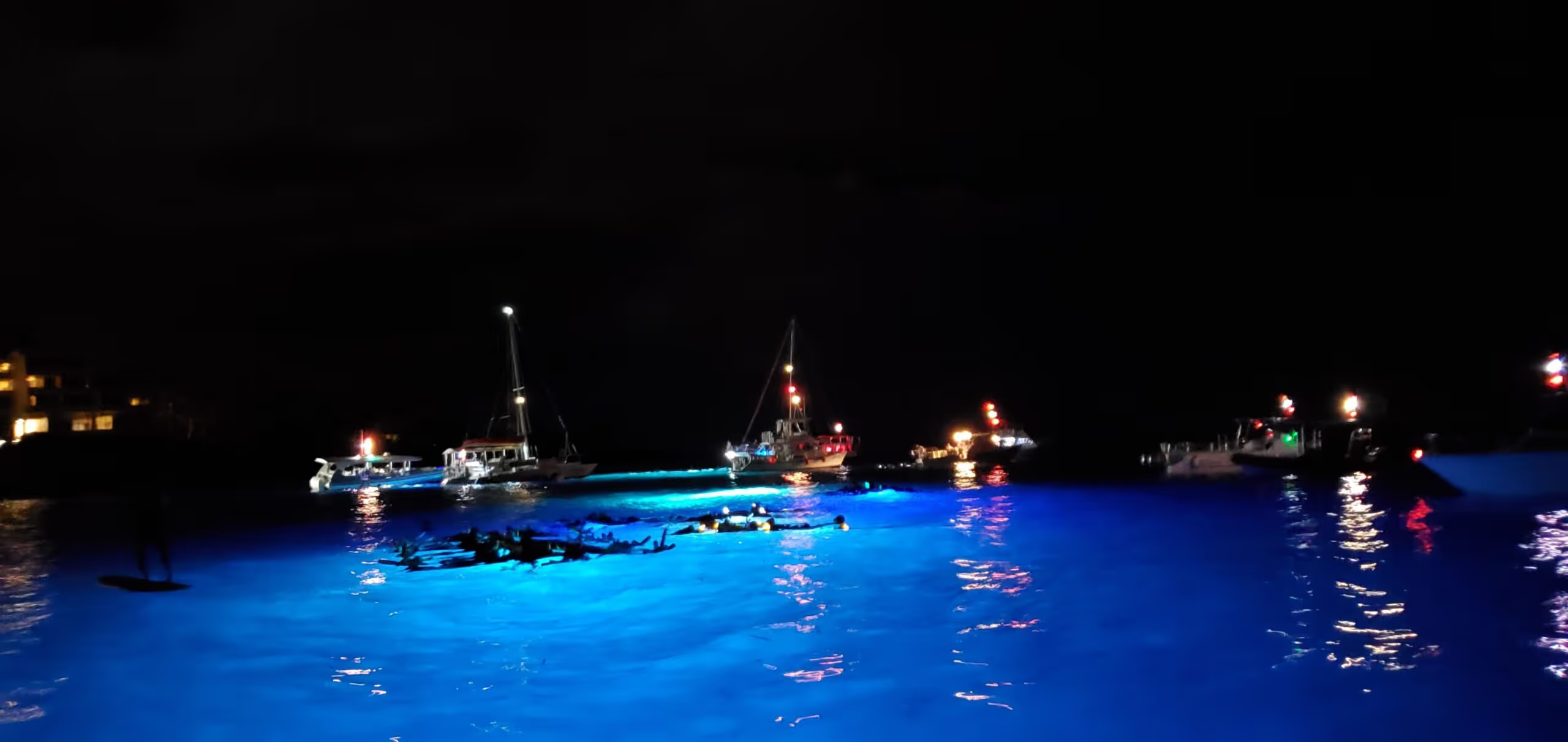
While scuba diving with manta rays is popular, snorkeling is widely considered the ultimate way to experience this phenomenon. Because the high-powered LED lights are mounted directly on floating surface rafts, the highest concentration of plankton gathers right at the surface. Consequently, the manta rays spend the vast majority of their time feeding just inches below the snorkelers.
As a snorkeler, you get a front-row, panoramic view of the action. You float horizontally on the surface, looking down through clear water as the mantas rise up from the darkness, their white bellies illuminated by the lights as they barrel-roll directly toward your mask. Divers, on the other hand, sit on the sandy bottom (about 30 to 35 feet down) looking up, which offers a great perspective but means the rays are often feeding far above them.
To help you choose the right style of excursion, here is a comparison of how different tour formats operate along the Kona Coast:
| Feature | Small-Group Fast Boat Tours | Large Multi-Passenger Catamarans | DIY Shore Entry |
|---|---|---|---|
| Group Size | 6 to 12 guests maximum | 25 to 65 guests | N/A (Self-guided) |
| Transit Time | 3 to 10 minutes from Keauhou Bay | 30 to 45 minutes from distant harbors | None (climbing over rocks) |
| In-Water Time | 40 to 45 minutes | 30 to 40 minutes | Variable |
| Light Power | Ultra-bright custom LED boards | Standard vessel lights | Handheld dive lights |
| Safety Level | High (Dedicated in-water lifeguard guides) | Moderate (Many snorkelers to monitor) | Extremely Low (Highly dangerous shore entry) |
| Crowd Intimacy | Peaceful, close encounters | Crowded, chaotic light boards | Highly unpredictable |
Floating on the Surface: Manta Ray Snorkeling
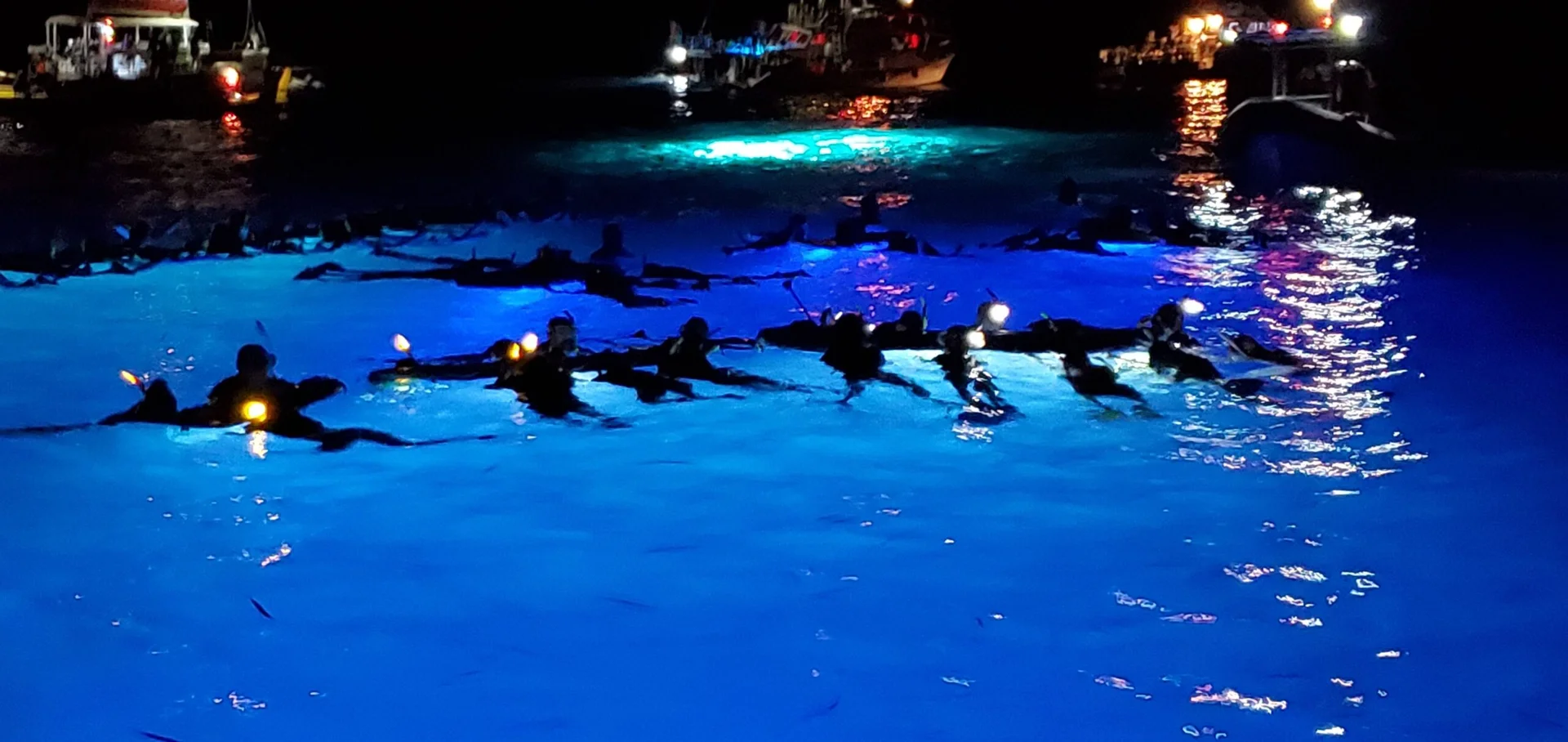
The mechanics of a modern manta ray snorkel are designed to be incredibly simple, making it accessible to almost anyone. Once the boat arrives at the feeding site, the crew deploys a specialized floating raft equipped with powerful, downward-facing LED lights.
Snorkelers enter the water one by one and hold onto the perimeter of this light board. To ensure everyone stays horizontal and comfortable for the duration of the 40-to-45-minute session, operators provide flotation belts or swim noodles.
Because you are simply floating and holding onto a stable raft, you do not need to be an Olympic swimmer to participate. However, basic comfort in the open ocean is required. If you want to brush up on your skills, you can read more about Manta Ray Snorkeling Kona to prepare for your night in the water.
Passive Interaction and Manta Manners
To keep this experience safe and sustainable, all reputable operators enforce a strict code of conduct known as "Manta Manners." The golden rule of swimming with manta rays is simple: look, but never touch.
Manta rays have a delicate, protective mucus layer coating their skin. This slime layer acts as their primary immune system, protecting them from marine bacteria, parasites, and infections. When a human touches a manta, this protective barrier is rubbed off, leaving the animal highly vulnerable to painful and potentially lethal infections.
To practice proper passive interaction, you must:
- Keep your body flat: Keep your legs floating horizontally behind you on the surface. Never let your feet dangle vertically, as a sudden kick can accidentally strike a feeding ray.
- Do not chase or swim after them: Let the rays control the distance. Because they are feeding on the plankton right next to the lights, they will naturally glide within inches of your body.
- Choose "Green List" operators: Always book with eco-conscious companies that are officially recognized for their commitment to sustainable tourism and strict adherence to conservation guidelines.
What to Bring and How to Prepare
Preparing for a night snorkel requires a bit of planning to ensure you stay warm and comfortable. Even in Hawaii's tropical climate, the ocean water temperature ranges from 75°F to 81°F (24°C to 28°C). While this feels warm initially, floating motionless on the surface for 45 minutes will slowly sap your body heat.
- Wetsuits: A high-quality wetsuit (typically 3mm thick) is essential. Reputable operators provide these at no extra cost, as they provide both thermal protection and natural buoyancy.
- Prescription Masks: If you wear glasses, standard snorkel masks will blur your vision. It is highly recommended to rent a prescription mask from local shops like Snorkel Bob's or Boss Frog's before your tour.
- Warm Layers: Bring a dry change of clothes, a towel, and a warm windbreaker or hoodie for the boat ride back to the harbor. The wind chill after dark can make the return journey feel surprisingly cold.
Sunset vs. After-Dark: Choosing the Best Kona Hawaii Manta Ray Tour
When booking your Manta Ray Night Snorkel Kona, you will generally have to choose between two distinct departure windows: the Sunset Tour or the After-Dark Tour. Both options offer incredible opportunities to see the rays, but they cater to very different preferences.
The Scenic Sunset Experience
The sunset departure typically leaves the harbor just before the sun dips below the horizon. This is a highly scenic option that allows you to enjoy the stunning golden hour views over the Kona Coast and the towering peak of Hualalai.
This tour is highly recommended for:
- Nervous or first-time snorkelers: Entering the ocean while there is still ambient twilight helps ease the anxiety of swimming in the open ocean. You can get comfortable with your gear and see the bottom before darkness falls.
- Families with younger children: Kids often prefer being able to see their surroundings as they get into the water.
- Photographers: You can capture beautiful split-shots of the sunset above the water and the marine life below.
As the twilight fades, the crew turns on the light boards, and you watch the magical transition as the ocean turns to ink and the manta rays emerge from the deep. For a deeper dive into what to expect during this transition, check out our guide on Everything You Need to Know About Manta Ray Snorkeling in Kona.
The Immersive After-Dark Adventure
The late-night, after-dark tour departs in pitch-black conditions. Without any ambient sunlight, the contrast between the dark ocean and the ultra-bright LED light boards is incredibly dramatic.
This option is perfect for:
- Adventure seekers: The experience of riding out into the dark ocean under a canopy of stars is thrilling.
- More intimate encounters: Because many of the larger commercial boats only run sunset tours, the after-dark departures often feature fewer boats and fewer snorkelers at the feeding sites.
- Intense feeding action: With no sunlight to compete with, the plankton is highly concentrated around the artificial lights, which can draw a higher number of active, feeding mantas.
If you are looking for a highly focused, dramatic encounter with the gentle giants, this late-night option is widely considered The Most Exciting Activity: A Manta Ray Snorkel in Kona.
Frequently Asked Questions about Kona Hawaii Manta Ray Tours
What is the best time of year to see manta rays in Kona?
Manta rays can be seen in Kona year-round. Because our resident reef manta population does not migrate, sighting success rates remain consistently high (over 90%) regardless of the month.
However, seasonal ocean conditions do vary. The summer months (June through October) bring slightly warmer water temperatures (around 80°F to 81°F) and generally calmer seas. The winter months (December through March) bring cooler water temperatures (around 75°F to 76°F) and occasional swells, though operators will monitor the weather closely to ensure safe transit.
Are manta rays dangerous to swim with?
No, manta rays are completely harmless to humans. They are often confused with stingrays due to their similar shape, but mantas do not have stingers, barbs, or poison.
Furthermore, they have no teeth to bite you with—they are filter feeders that consume only microscopic plankton. The main safety concern during a tour is simply maintaining your distance so that their massive, fast-moving bodies do not accidentally bump into you as they perform their barrel rolls.
What happens if we don't see any manta rays on our tour?
While the sighting success rate is incredibly high, manta rays are wild animals, and there are rare nights when they simply decide to feed elsewhere.
To protect your investment, most reputable, ethical operators offer a "Manta Guarantee." If you do not see at least one manta ray during your charter, you will be allowed to book a return trip for free on a standby basis during your vacation. Because of this, it is highly recommended to book your tour near the beginning of your stay on the Big Island so you have plenty of backup nights available if needed.
Conclusion: Booking Your Unforgettable Manta Ray Adventure
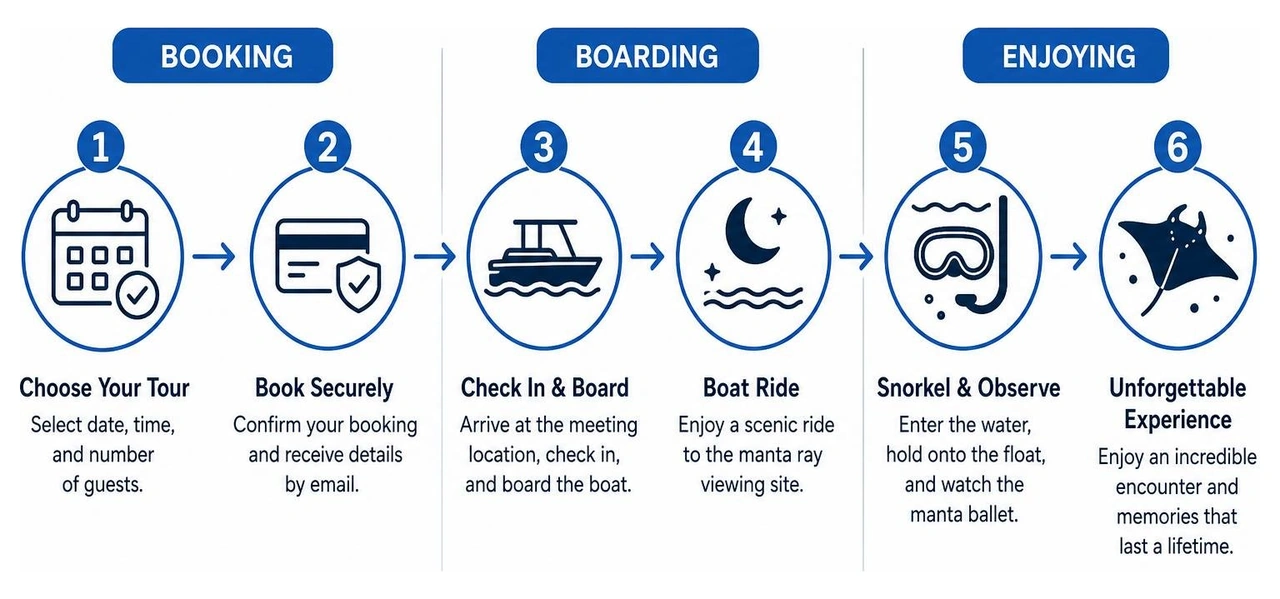
Swimming with the Kona, Hawaii manta rays is a transformative experience that deserves a spot on every traveler's itinerary. From the historical origins of Keauhou Bay to the thrilling "manta ballet" beneath the stars, this activity highlights the incredible magic of Hawaii's marine environment. By choosing an ethical operator and practicing proper "Manta Manners," you can ensure this unique encounter remains safe and sustainable for generations to come.
Why a Small-Group Kona Hawaii Manta Ray Tour Offers the Best Experience
At Dolphin Discoveries, we believe that a bucket-list experience should never feel like a crowded amusement park ride. Our ocean tours depart directly from Keauhou Bay—the historic birthplace of the manta ray night snorkel.
By choosing our small-group, naturalist-led tours, you enjoy several key advantages:
- Fast, comfortable boats: Our rigid-hull inflatable speedboats get you to the manta feeding sites in just a few minutes, minimizing travel time and maximizing your time in the water.
- Intimate group sizes: We avoid the massive, crowded catamarans carrying 40 to 60 people. Our small groups ensure you get personalized attention from our expert captains and in-water guides.
- Strong eco-conservation focus: Our guides are passionate marine naturalists who educate guests on manta biology, local history, and passive interaction guidelines to protect our resident reef population.
Ready to secure your spot for this magical night? Explore our availability and book your Manta Ray Night Snorkel Kona today!