


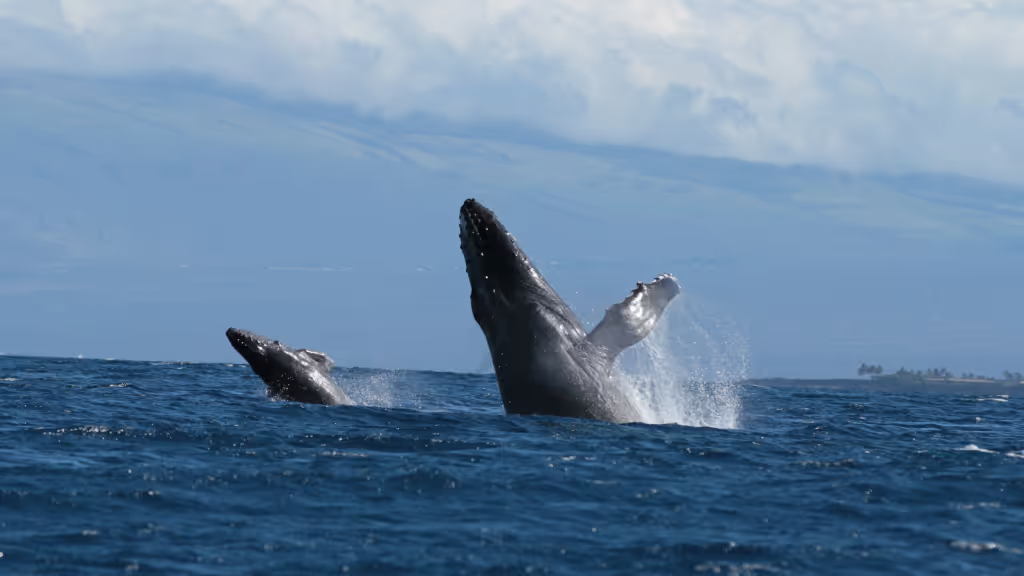
Few sights on a winter whale watch beat a small humpback surfacing right next to its mother. Hawaii is where humpback whale calves are born, and the waters off Kona are part of that nursery. This guide covers how calves are born and raised in Hawaii, why mothers make the long trip here, what calf behavior looks like from a boat, and how to give mothers and calves the space they need.
Why Humpback Whale Calves Are Born in Hawaii
Each winter, about 10,000 humpback whales travel more than 3,000 miles from Alaska to Hawaii. Hawaii is the only US state where humpbacks reproduce, and the whales don't feed while they are here. The Hawaiian Islands Humpback Whale National Marine Sanctuary says that in Hawaii, humpbacks breed, give birth and nurse their young.
Hawaii's Division of Aquatic Resources (DAR) explains why the trip is worth it for a newborn:
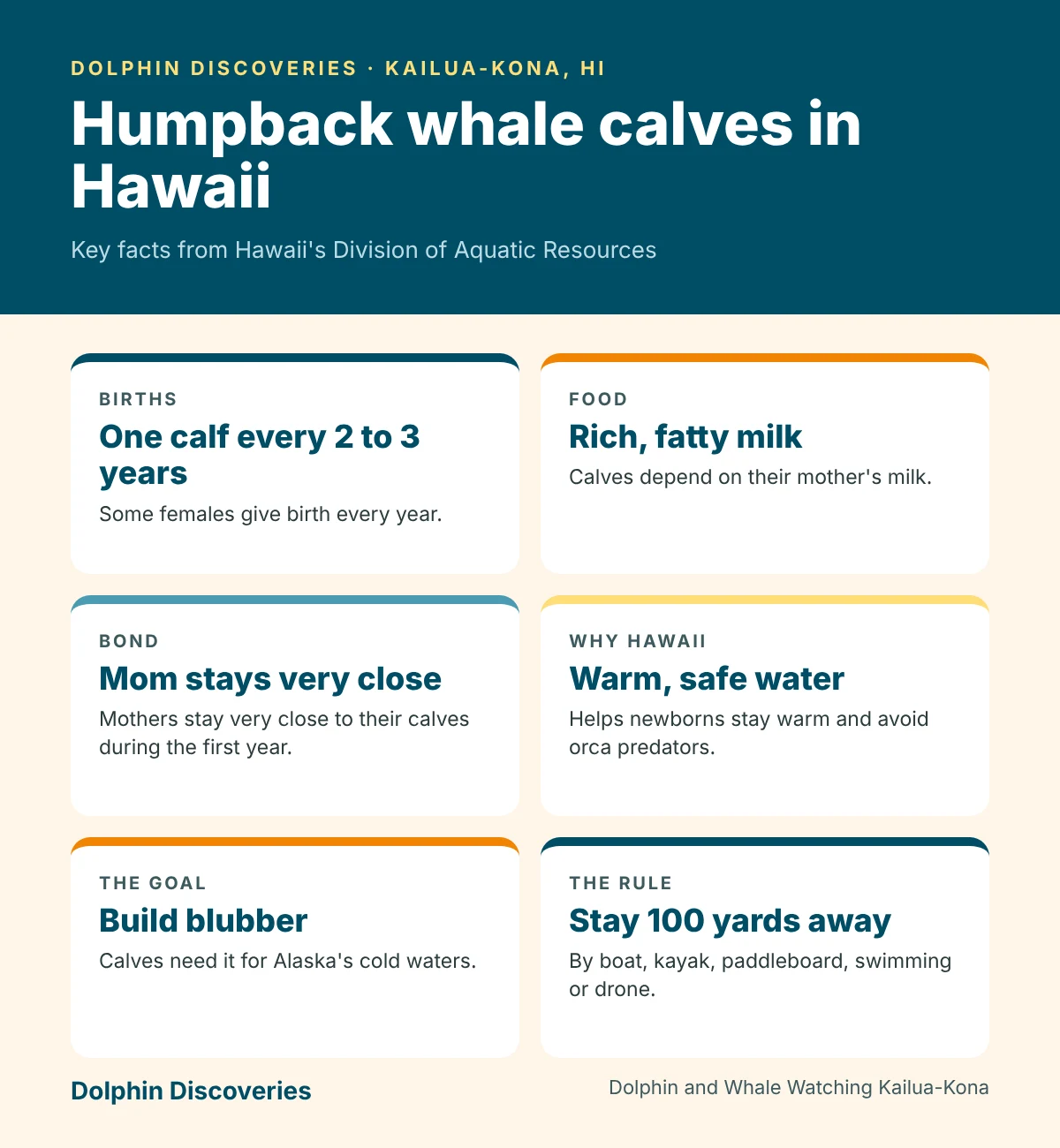
- Warmth - Hawaii's warm waters help newborn calves stay warm.
- Safety - The same waters help calves avoid orca predators.
- Growth - These conditions let calves build the blubber they will need for Alaska's cold waters.
Once the calves are strong enough, the whales migrate back to Alaska to feed again.
How Often Do Humpbacks Have Calves?
DAR says female humpbacks typically have one calf every 2 to 3 years, though some give birth every year.
Calves are also a good sign for the population. DAR notes that in 2016, the number of returning whales dropped by at least half, with noticeably fewer calves. That makes every mother and calf pair you see in Kona waters worth celebrating.
How Humpback Mothers Raise Their Calves
A humpback calf leans on its mother for almost everything in its first months. DAR says mothers stay very close to their calves during the first year and provide the rich, fatty milk the calves depend on.
Remember that adult humpbacks don't feed in Hawaii. A mother is nursing a growing calf on the energy she stored up in Alaska. That is one reason it matters so much that boats and people don't disturb mothers and calves while they rest.
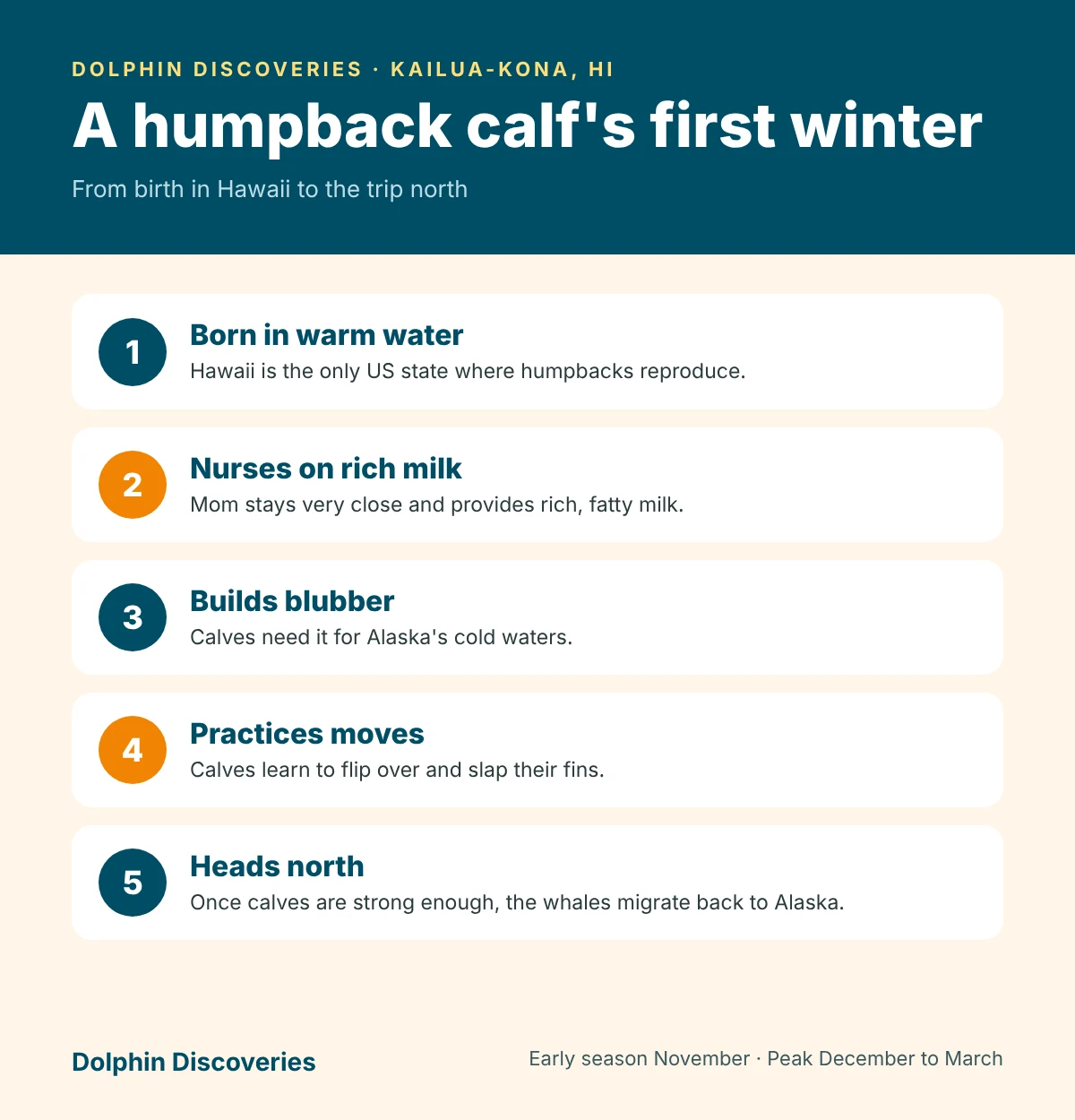
A calf's first winter, step by step
- Born in warm water - Calves are born in Hawaii, the only US state where humpbacks reproduce.
- Nurses on rich milk - Mom stays very close and provides rich, fatty milk.
- Builds blubber - Calves need that layer for Alaska's cold waters.
- Practices moves - Calves learn to flip over and slap their fins.
- Heads north - Once calves are strong enough, the whales migrate back to Alaska.
What Calf Behavior Looks Like From a Boat
Calves are often more active at the surface than you might expect. On our tours, guests sometimes see calves learning to flip over and slap their fins. DAR lists the surface behaviors people see during whale season as breaching, spy hopping, tail slaps, peduncle throws and pectoral fin slaps. Among the reasons DAR gives for this activity are protective mothers, communication, curiosity and play.
Here is what to watch for:
- Fin slaps - Calves practice slapping their fins at the surface.
- Rolling over - Calves learn to flip over.
- Breaches and spy hops - Whales of all ages may launch out of the water or lift their heads to look around.
Our captains also watch for groups of adults, including competition pods. Keep your eyes on the water all around the boat.
When to See Humpback Calves in Kona
Early whale season in Kona starts in November. Peak season runs from December through March. This is an El Niño year, and whale timing can be hard to predict, so sightings are never guaranteed. Our Big Island whale season guide has more on planning your dates.
Spinner, bottlenose and pantropical spotted dolphins live off Kona all year, so a winter tour can include more than whales.
See Humpback Calves on a Kona Whale Tour
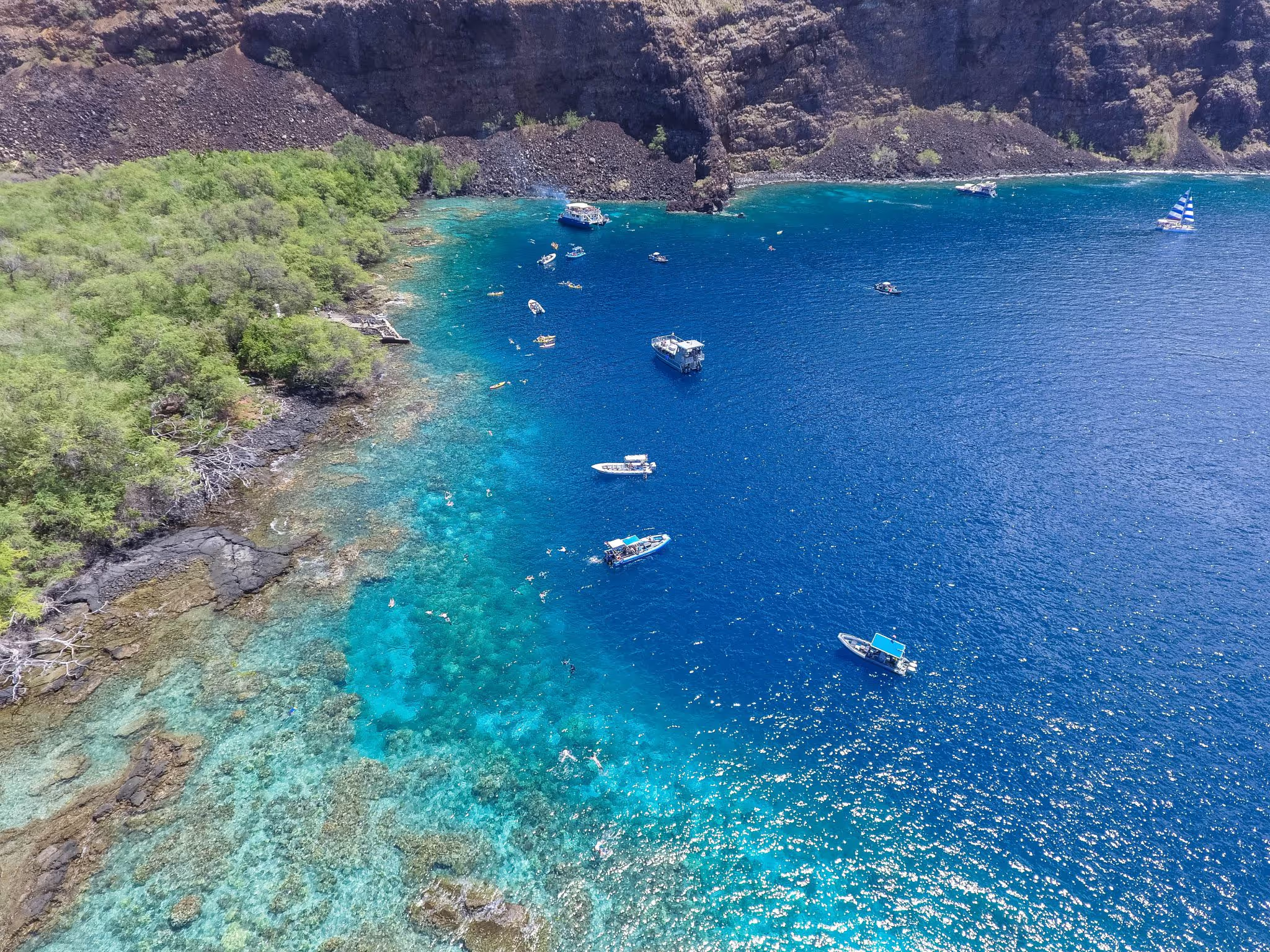
Our whale watching Kona tour, Dolphin and Whale Watching Kailua-Kona, leaves from Keauhou Bay. Kona is home to the southernmost whale watching in the United States, and we are the only whale-watching operator departing Keauhou Harbor.
- Length: 2.5 hours, with check-in time built into the schedule
- Price: $99.99
- Ages: 5 to 70
- Group size: 6 to 20 guests
- Swimming: None. This is a watching tour.
- On board: Captain narration, binoculars, an underwater hydrophone, island juices and water
What to expect
- Check in - Meet us at our store in Keauhou Shopping Center, 78-6831 Ali'i Dr Suite F-146, Kailua-Kona. Please arrive no more than 10 minutes before your check-in time.
- Board at Keauhou Bay - Our small-group RHIBs head out along the coast.
- Scan for blows - Binoculars are available on board.
- Listen in - The hydrophone lets you hear what is happening below the surface.
- Hear the story - Your captain explains what you are seeing, from calves to competition pods.
Prone to motion sickness? Read our tips on how long seasickness lasts, and check Know Before You Go for what to bring. Want the boat to yourselves? A Kona private boat tour is 4 hours, customizable, and fits up to 28 guests. You can book it on our website or call (808) 322-8000 with questions.
Give Mothers and Calves Their Space
DAR says not to approach a humpback within 100 yards (300 feet) by any means, including boats, kayaks, paddleboards, swimming and drones. DAR also notes that whales, especially calves, are still struck by vessels every year. If you see an injured or entangled whale, call the NOAA hotline at (888) 256-9840. You can learn more on our Learn About Whales page.
Frequently Asked Questions
Where are humpback whale calves born?
North Pacific humpbacks travel to Hawaii to give birth. Hawaii is the only US state where humpbacks reproduce, and the warm water helps newborns stay warm and avoid orcas.
How often do humpback whales have calves?
Hawaii's Division of Aquatic Resources says females typically have one calf every 2 to 3 years, though some give birth every year.
What do humpback whale calves eat?
Calves depend on their mother's rich, fatty milk. Adult humpbacks don't feed in Hawaii, so mothers nurse on the energy they stored in Alaska.
How long do calves stay with their mothers?
DAR says mothers stay very close to their calves during the first year. Once calves are strong enough, they migrate with the whales back to Alaska.
Can you see baby humpback whales on a Kona tour?
Yes, mothers and calves are often part of the winter whale season. Early season starts in November and peak season runs December through March. Whales are wild animals, so sightings are never guaranteed.
How close can boats get to a mother and calf?
No closer than 100 yards. That rule applies to boats, kayaks, paddleboards, swimmers and drones.
Ready to look for mothers and calves? Book a Dolphin and Whale Watching Kailua-Kona tour on our website, or call (808) 322-8000 with questions.