

One of Hawaii's Most Unforgettable Wildlife Encounters Happens After Dark
A big island Kona manta ray night snorkel is one of the most reliable and awe-inspiring wildlife experiences on the planet — and Dolphin Discoveries runs it right from Keauhou Bay, the very place where this tradition began.
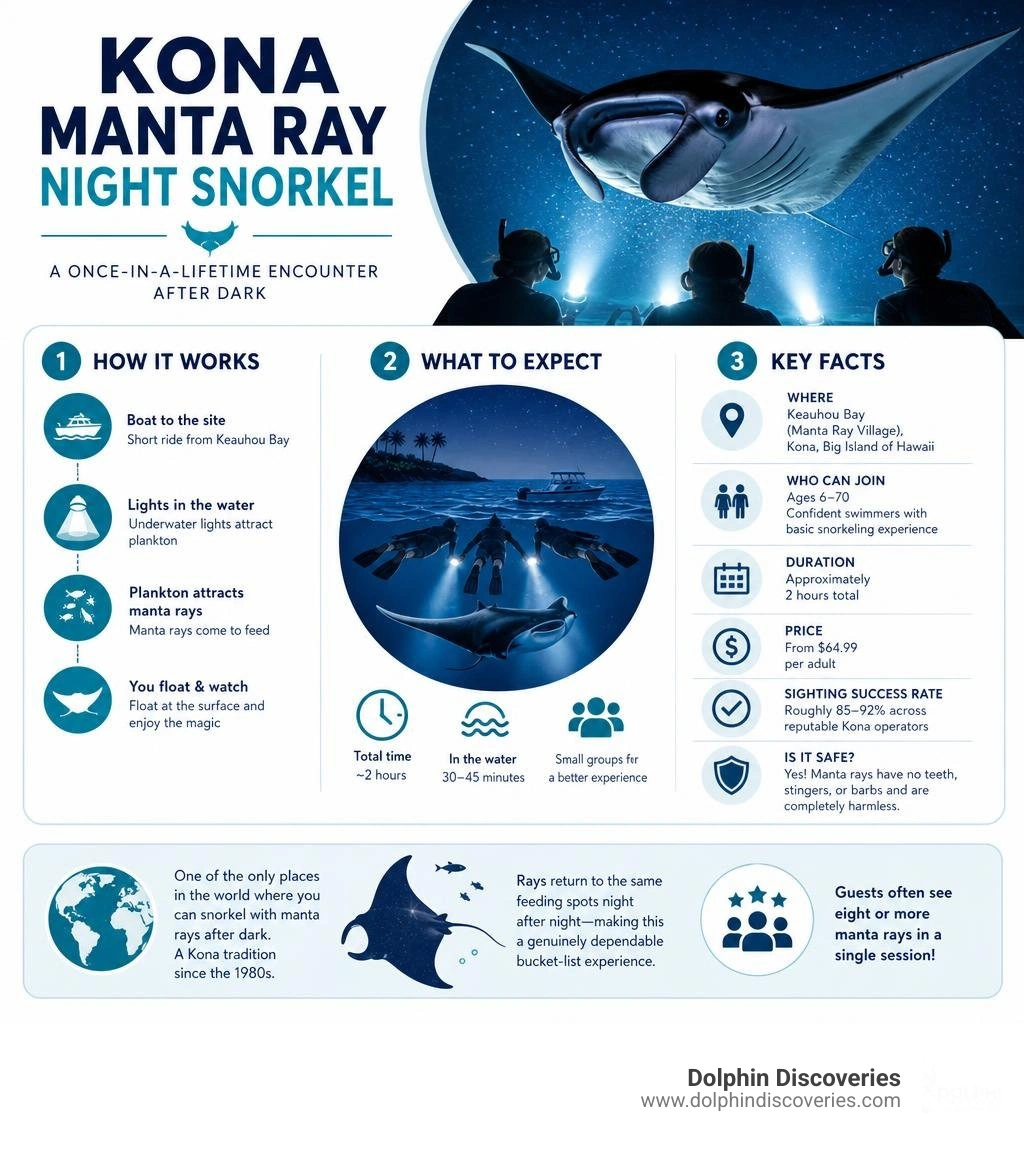
Here's what you need to know at a glance:
- What it is: A guided evening snorkel where underwater lights attract plankton, which draws wild manta rays to feed just inches below you
- Where: Keauhou Bay (also called Manta Ray Village), Kona, Big Island of Hawaii
- Duration: Approximately 2 hours total, with around 30–45 minutes in the water
- Who can join: Ages 6–70, confident swimmers with basic snorkeling experience
- Price: From $79.99 per adult
- Sighting success rate: Roughly 85–92% across reputable Kona operators
- Is it safe? Yes — manta rays have no teeth, stingers, or barbs and are completely harmless
Kona is one of the only places in the world where you can snorkel with manta rays after dark, and it has been happening here since the 1980s. The rays return to the same feeding spots night after night, making this a genuinely dependable bucket-list experience.
Dolphin Discoveries holds a 4.8 out of 5 rating based on over 5,100 reviews, with guests regularly describing encounters with eight or more manta rays in a single session.
Read on to learn exactly how the experience works, what to bring, and how to make the most of your night in the water.
The Magic and Science of the Night Snorkel
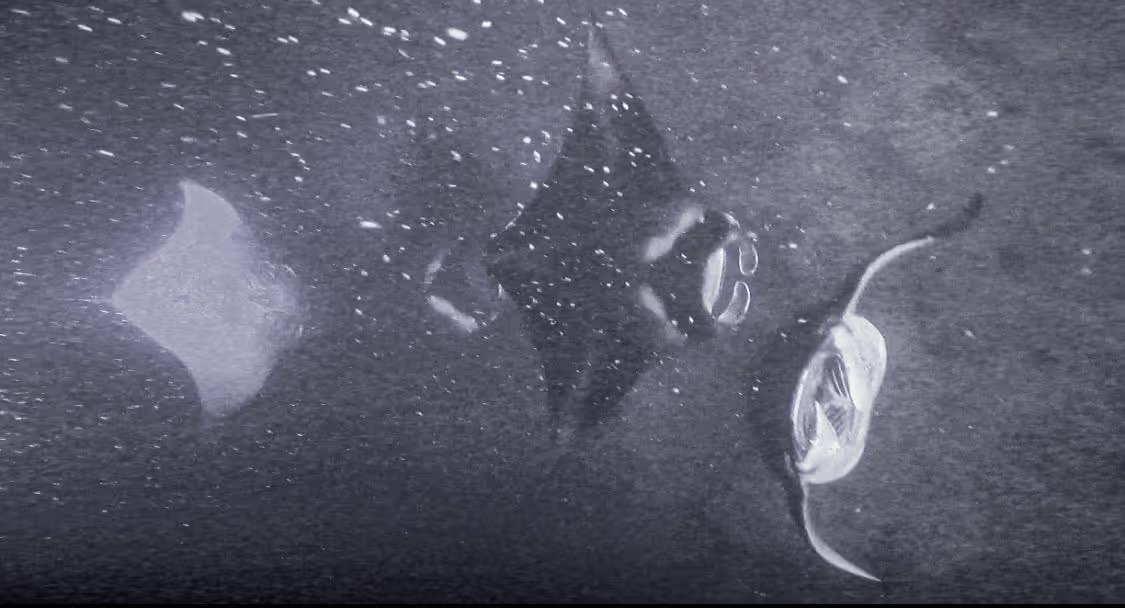
When you slip into the dark Pacific waters off the Kona Coast at night, you are stepping into an entirely different world. The transition from day to night in the ocean brings about a dramatic shift in marine life behavior. While many daytime fish find crevices in the reef to sleep, the ocean's microscopic wanderers — plankton — rise toward the surface. This nightly migration sets the stage for one of nature's most spectacular performances.
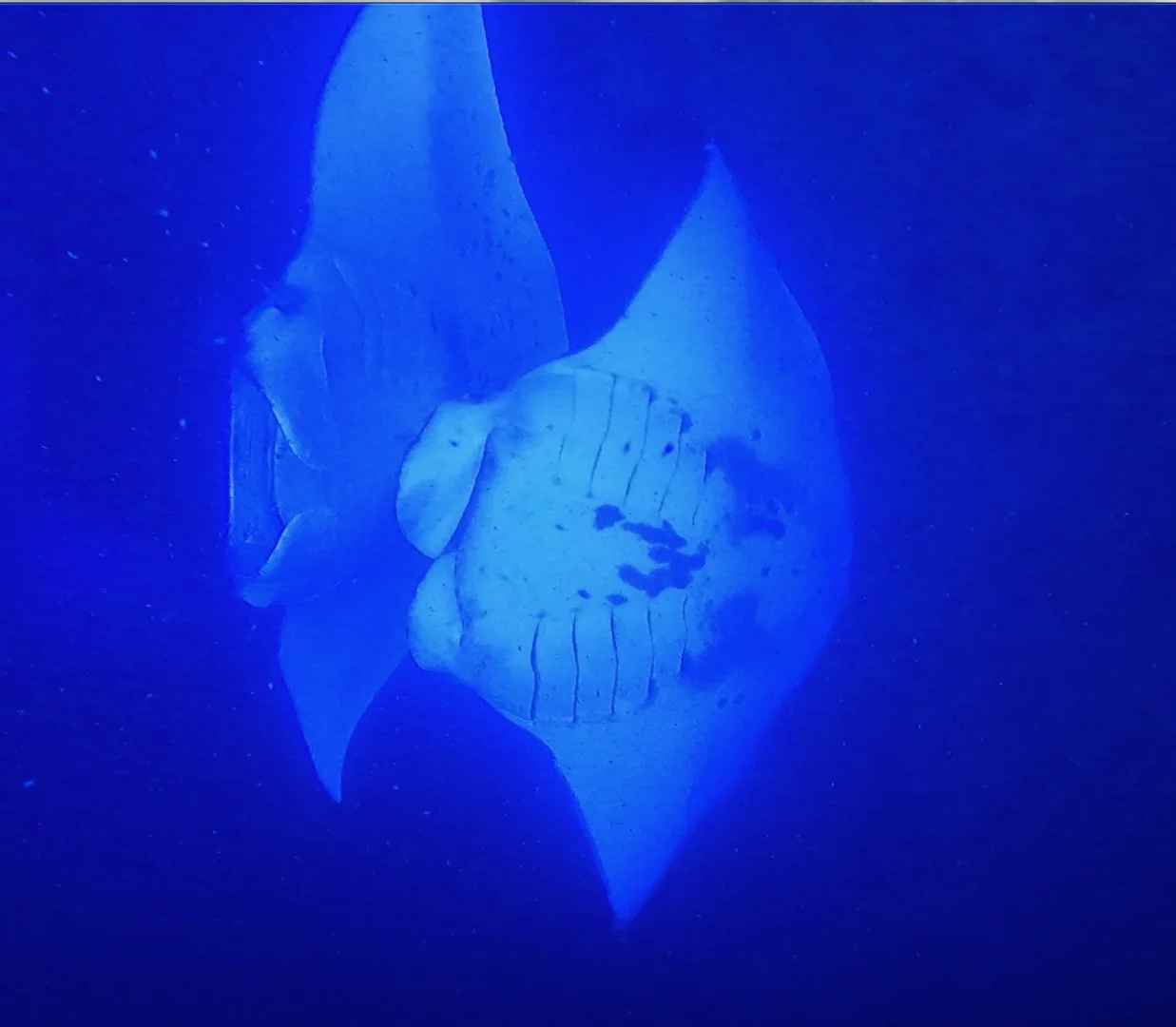
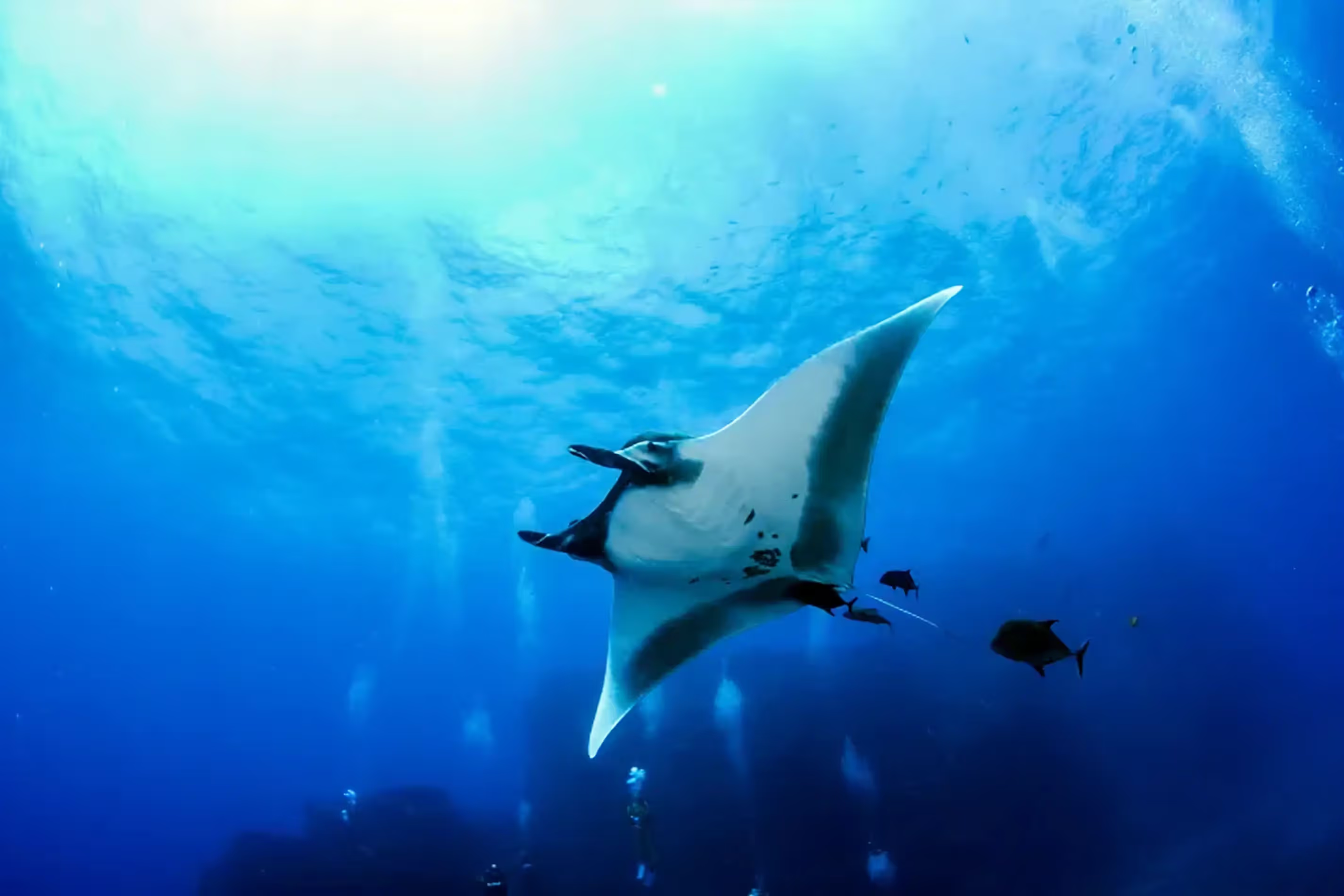
The star of this nighttime ballet is the reef manta ray (Mobula alfredi). Unlike their larger pelagic relatives, reef manta rays are frequent residents of shallow coastal waters. These gentle giants can grow to wingspans of up to 14 to 16 feet and weigh upwards of 1,000 pounds. Despite their intimidating size, they are completely harmless.
Mantas are cartilaginous fish, meaning their skeleton is made entirely of cartilage and muscle rather than bone, allowing them to bend, twist, and glide with incredible flexibility. They do not have teeth, stingers, or venomous barbs. Instead, they are filter feeders that rely on specialized structures called cephalic fins — the flexible flaps on either side of their mouths — to funnel water and plankton into their cavernous mouths.
To dive deeper into the biology, anatomy, and behavior of these majestic creatures, you can Learn About Manta Rays before embarking on your trip. Seeing them up close is a humbling reminder of the ocean's delicate food web, a sentiment echoed by hundreds of travelers in their Manta Ray Night Snorkel at Kona, Big Island (with Reviews).
What is a Big Island Kona Manta Ray Night Snorkel?
So, how did humans and manta rays start hanging out after dark in Keauhou Bay? The origin of this world-famous encounter dates back to the late 1970s and early 1980s. The nearby beach resort illuminated the shallow waters of Keauhou Bay with powerful floodlights so guests could enjoy the evening surf.
Before long, locals noticed that a single resident manta ray discovered the concentrated buffet of plankton attracted by the lights. Over the decades, more manta rays joined in, creating a learned feeding behavior that passed down through generations. Today, this location is affectionately known as "Manta Ray Village," and it remains the birthplace and premier spot for the big island Kona manta ray night snorkel.
During a modern tour, we recreate this phenomenon using specialized, high-intensity light boards. You hold onto the handles of a floating raft equipped with downward-pointing lights, allowing you to watch the action unfold directly beneath you. For an in-depth look at how these tours operate and why Keauhou Bay is the perfect venue, check out our guide on Manta Ray Snorkeling Kona.
The Science of the "Campfire" and Plankton Attraction
The heart of the night snorkel experience is what guides and divers call the "campfire." This is not a literal fire, of course, but a concentrated circle of powerful LED lights positioned on the ocean floor by scuba divers or integrated into floating boards at the surface.
This setup initiates a fascinating ecological chain reaction:

- The Light Source: Tour operators deploy high-intensity LED lights (sometimes generating up to 150,000 to 200,000 lumens).
- The Plankton Convergence: Microscopic marine organisms, including phytoplankton and tiny shrimp-like zooplankton, naturally drift toward the light source.
- The Feast Begins: Manta rays, sensing the dense concentration of their favorite food, swim into the light beam to feed.
Because the plankton is highly concentrated directly in front of the lights, the manta rays must feed efficiently. To do this, they perform a breathtaking maneuver known as a "barrel roll" or "feeding loop." They glide upward, loop backward in a perfect underwater somersault, and pass within inches of your snorkel mask with their mouths wide open. It looks like a beautifully choreographed dance, but it is actually a highly efficient filter-feeding strategy!
Planning Your Big Island Kona Manta Ray Night Snorkel
Planning ahead is essential to securing your spot on this popular excursion. Because we limit our boat capacities to ensure an intimate, small-group experience, tours regularly sell out weeks in advance.
To help you decide which style of tour fits your vacation itinerary, we have compared the two primary departure times below:
| Feature | Sunset Manta Tour | After-Dark Manta Tour |
|---|---|---|
| Departure Time | Around 5:00 PM – 5:30 PM | Around 7:00 PM – 7:30 PM |
| Boat Ride Experience | Scenic sunset views, potential "green flash" | Stargazing under clear, dark Hawaiian skies |
| In-Water Visibility | Transition from twilight to deep blue | High-contrast, dramatic light beams |
| Vibe | Great for families and landscape photography | Immersive, quiet, and highly dramatic |
| Sighting Consistency | Extremely high (90%+) | Extremely high (90%+) |
No matter which time you choose, booking early in your Big Island vacation is highly recommended. This gives you a buffer window in case a tour must be rescheduled due to unexpected ocean swells or weather conditions. You can check real-time availability and secure your seats directly via our Manta Ray Night Snorkel Kona Tour booking page.
Best Time of Year and Weather Considerations
One of the best aspects of the big island Kona manta ray night snorkel is that it is a year-round activity. Unlike humpback whales, which only visit Hawaii during the winter months, our resident reef manta rays do not migrate. They stay in Kona’s coastal waters year-round, enjoying the consistent water temperatures and abundant food supply.
That being said, seasonal changes do bring slight variations to the experience:
- Summer (June to October): Water temperatures are at their warmest, ranging from 78°F to 80°F (25°C to 27°C). Ocean swells are typically calm, making for highly comfortable snorkeling conditions.
- Winter (December to March): Water temperatures dip slightly to around 74°F to 76°F (23°C to 24°C). While still comfortable, you will definitely appreciate the insulated wetsuit tops we provide. Winter can also bring occasional northern swells, which our captains monitor closely to ensure safe boarding and snorkeling.
Regardless of the season, our captains always prioritize guest safety. If a tour is canceled due to rough sea conditions, we will work with you to rebook your trip or provide a full refund.
Sunset vs. After-Dark Tours
Deciding between a sunset departure and a late-night departure often comes down to personal preference.
The Sunset Tour is incredibly scenic. As we cruise out of Keauhou Bay, you will watch the sun dip below the Pacific horizon. If you are lucky, you might even catch the elusive "green flash" — a brief optical phenomenon that occurs just as the sun disappears. Snorkeling during twilight is a gentle way to ease into the night, as there is still a faint ambient glow in the sky when you first enter the water.
The After-Dark Tour, on the other hand, is pure drama. Under a pitch-black sky, the only light comes from our custom-designed swim boards slicing through the dark water. The contrast between the black ocean and the illuminated beams of light creates a theatrical stage. Many guests find this late-night option to be more peaceful, as there are often fewer boats on the water, resulting in an incredibly intimate encounter with the rays.
What to Expect on Your Nightly Adventure
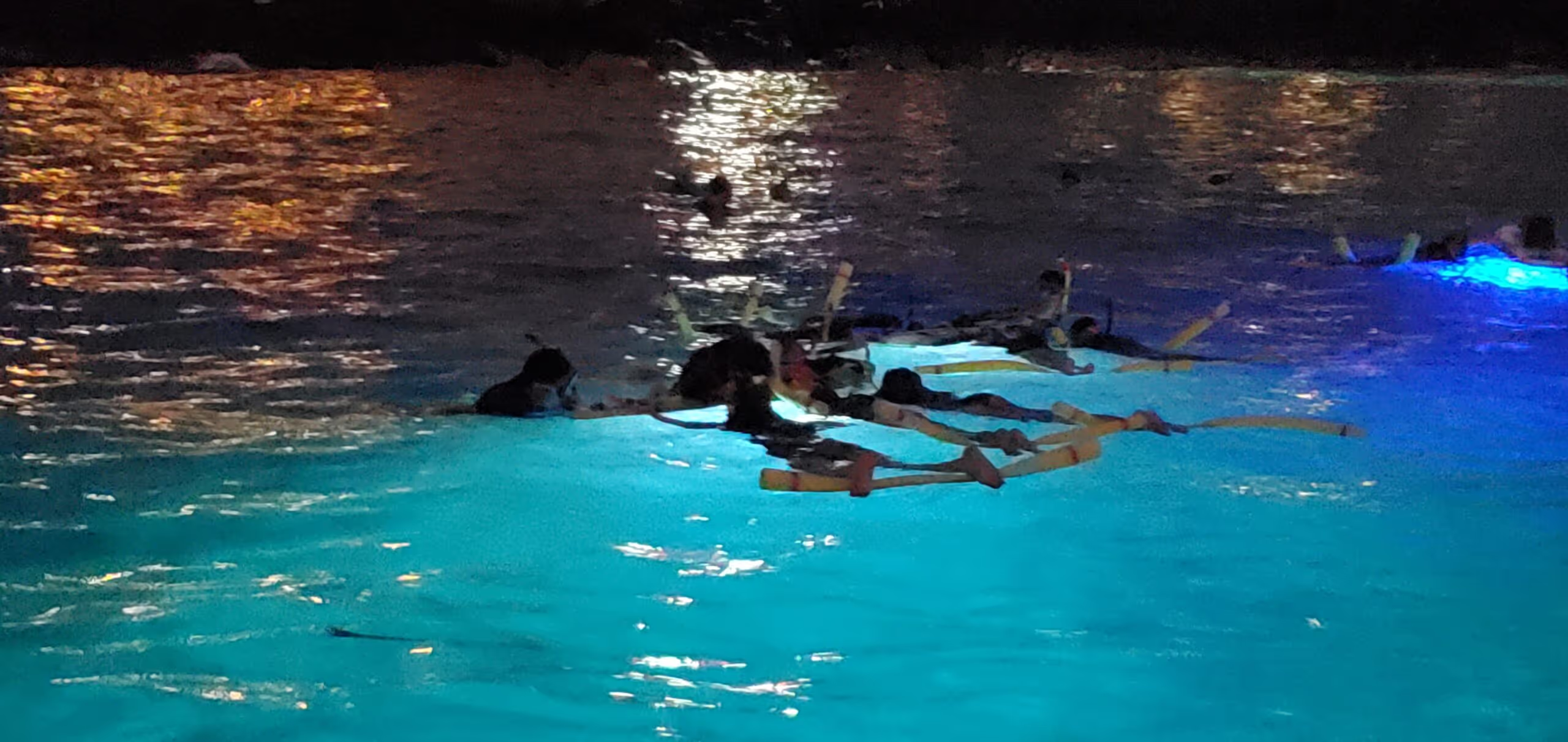
Knowing what to expect before you step onto the boat can help calm any pre-trip jitters, especially if you have never snorkeled in the open ocean at night. From check-in to the final boat ride back to the harbor, every step of our tour is designed for comfort, safety, and fun. For a complete, step-by-step walkthrough of the evening, you can read our detailed guide on What to Expect on a Big Island Manta Ray Snorkel Trip.
Preparing for Your Big Island Kona Manta Ray Night Snorkel
Preparation starts before you even arrive at Keauhou Bay. Here are a few essential tips to keep in mind:
- Reef-Safe Sunscreen: Since this is a night tour, you won't need sunscreen for the snorkel itself! However, if you are applying sunscreen earlier in the day, please ensure it is a non-nano zinc oxide formula to protect our delicate coral reefs.
- Warm Layers and Towels: The boat ride back can feel surprisingly chilly once you are wet and the evening breeze picks up. Bring a dry towel and a warm, windproof jacket or hoodie to wrap up in after your swim.
- Physical Readiness: Guests must be in good physical health, free of major neck, back, or heart conditions, and able to climb a sturdy metal ladder to get back onto the boat from the water.
In-Water Experience and Manta Etiquette
Once we arrive at the snorkel site (usually a quick 3- to 5-minute boat ride from the harbor), our crew will assist you into the water. You will be outfitted with a professional snorkel mask, a snorkel, and a high-quality neoprene wetsuit top, which provides both warmth and natural buoyancy.
Our guides will direct you to hold onto the secure handles of our custom floating light board. Your primary job is simple: float flat on your stomach and enjoy the show.
To ensure the safety of both our guests and the marine life, we strictly adhere to the guidelines set by the Manta Green List and local conservation groups. These rules are designed to foster respectful, passive interaction:
- Look, Don't Touch: Manta rays have a protective mucus coating on their skin that shields them from bacteria and parasites. Touching them can damage this layer, so we must never reach out to touch, pet, or chase them.
- Stay Flat: Keep your legs floating horizontally at the surface. Bending your knees or letting your legs dangle vertically can result in accidental kicks to the mantas as they swoop up from below. To ensure everyone stays flat, we do not use swim fins on this tour.
- Let Them Initiate: The mantas are incredibly curious and comfortable around the lights. If you remain calm and still, they will often glide close enough to brush past your chest — let them make the rules of engagement!
By practicing responsible snorkeling, we help preserve this incredible ecosystem for years to come. To learn more about the deep connection between Hawaii's culture and these marine animals, read about The Majesty of a Night Manta Ray Adventure in Kona Hawaii.
Frequently Asked Questions about Kona Manta Snorkeling
Are manta rays dangerous to swim with?
Not at all! This is one of the most common misconceptions. While their name sounds similar to stingrays, manta rays are entirely different. They do not have a stinging barb on their tail, they have no teeth, and they do not possess any venom. They are gentle, curious filter feeders that pose absolutely no threat to humans. You can swim alongside them with complete peace of mind.
What happens if we don't see any manta rays?
Manta rays are wild, free-roaming animals, which means their presence can never be 100% guaranteed. However, because Keauhou Bay has a resident, non-migratory population, our success rate is incredibly high — averaging between 85% and 92% year-round.
In the rare event that no manta rays are spotted during your tour, we do not offer monetary refunds, but we will happily invite you back to join us on another night for free on a standby basis (subject to seat availability).
Do I need to be an experienced swimmer or snorkeler?
Yes, basic swimming skills and comfort in the ocean are required. You must be able to swim at least 25 yards unassisted and comfortably hold onto the floating board.
While our wetsuit tops and flotation aids provide plenty of buoyancy to keep you effortlessly afloat, this tour is not recommended for complete non-swimmers. For safety reasons, we have a minimum age requirement of 6 years old and a maximum weight limit of 285 pounds.
Conclusion
A big island Kona manta ray night snorkel is more than just a tour; it is a life-changing encounter with some of the ocean's most graceful and majestic inhabitants. By choosing Dolphin Discoveries, you are opting for a small-group, eco-conscious adventure led by passionate marine naturalists who prioritize both your safety and the well-being of Hawaii's marine life.
Ready to experience the magic of Keauhou Bay for yourself? Spots on our fast boats fill up quickly, so book your reservation today. And if you want to explore the Kona Coast by day as well, don't miss our premier daytime Kona Snorkel Tour - Two Snorkeling Spots to swim over vibrant coral reefs and search for wild dolphins!