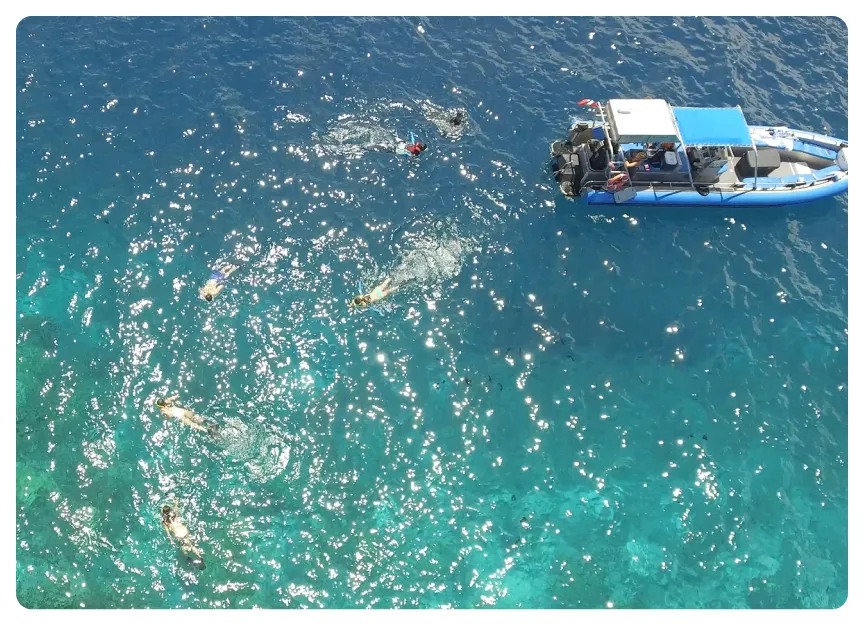




Put your face in the water at Kealakekua Bay and the reef fills with yellow, electric blue and black-and-white stripes. Within a minute, someone pops up and asks, "What was that?" This guide helps you answer. It covers four clues that make Hawaiian fish identification easier, ten reef fish you are likely to spot on a Kona snorkel, and the reef rules that keep those fish around.
Our species notes come from the Snorkeler's Guide to the Fishes of Hanauma Bay by Bishop Museum ichthyologist John E. Randall, published by the University of Hawai'i Sea Grant College Program. Hawaiian names follow that guide. One promise up front: fish are wild, so no one can say which ones will show up on a given day.
How to Identify a Hawaiian Reef Fish in 4 Clues
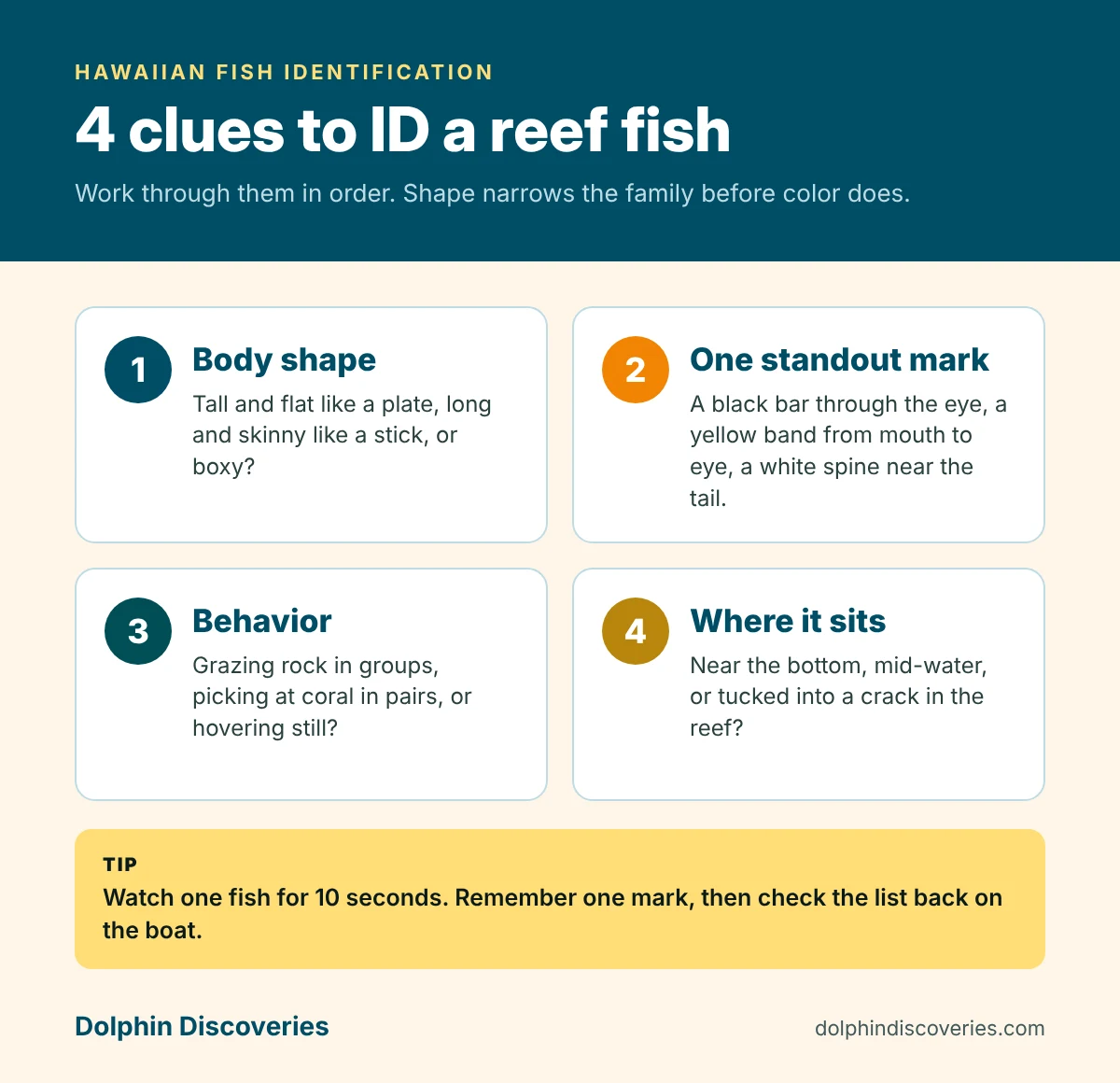
You don't need a waterproof chart to start. Work through these four clues in order.
- Body shape. Is the fish tall and flat like a plate, long and skinny like a stick, or boxy? Tangs, butterflyfish and the Moorish idol are tall and flat. Trumpetfish are long and thin. Boxfish live up to their name. Shape narrows the family before color does.
- One standout mark. Look for a single mark: a black bar through the eye, a yellow band from mouth to eye, a white spine near the tail. Overall color can fool you. Randall notes that male and female parrotfish and wrasses can look completely different.
- Behavior. Is it grazing on rock in a group, picking at coral in pairs, or hovering still? How a fish feeds is often the giveaway.
- Where it sits. Near the bottom, in mid-water, or tucked into a crack in the reef? Moray eels, for example, usually show only their heads.
Tip: watch one fish for 10 seconds. Remember one mark, then check the list back on the boat.
10 Hawaiian Reef Fish to Look for in Kona
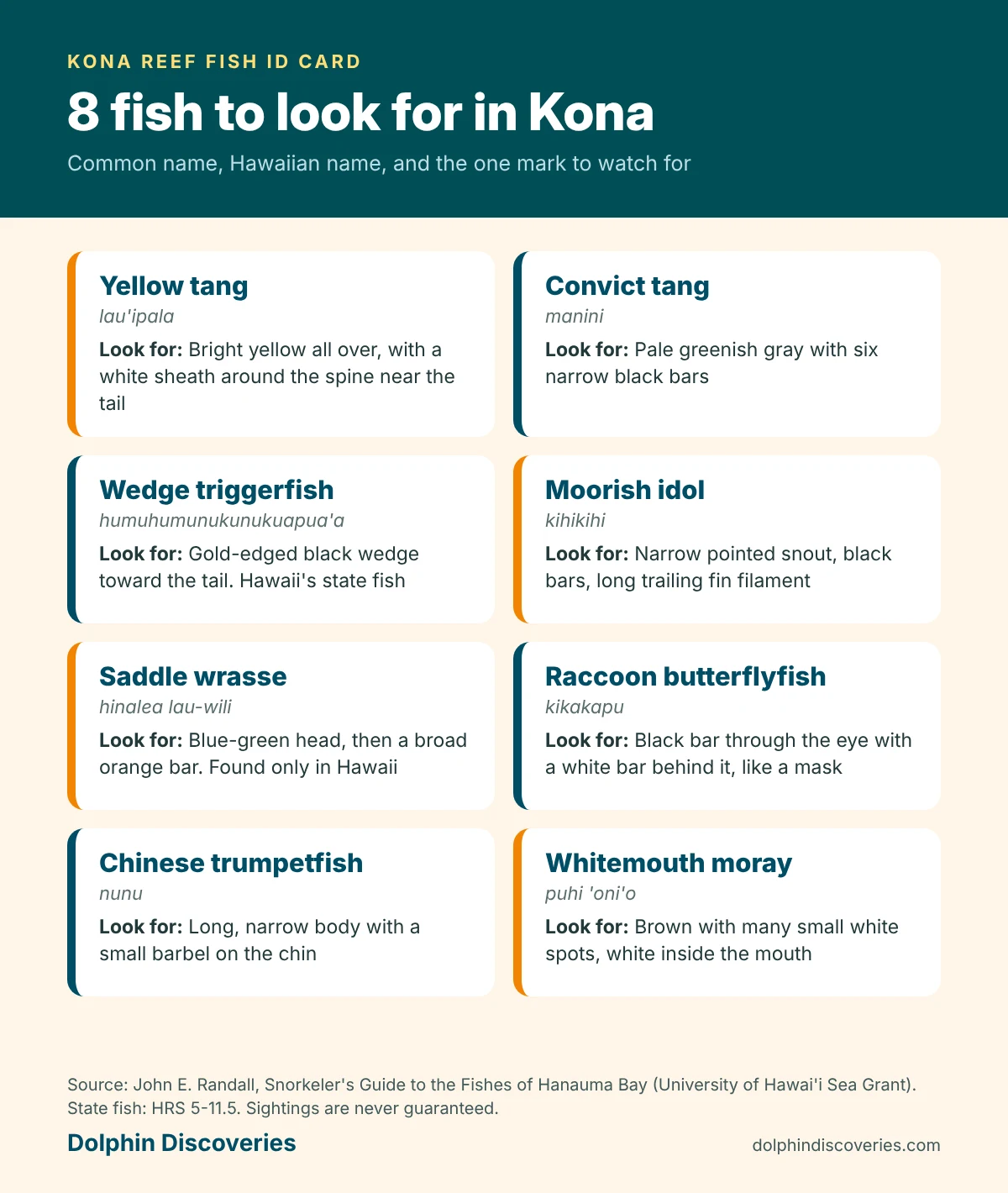
1. Yellow tang (lau'ipala)
Look for: bright yellow all over, with a white sheath around the spine near the tail. Adults graze on algae close to shore in calm areas. Randall calls it the number one fish of Hawaii's aquarium fish trade, so seeing a school of them in the wild is a treat.
2. Convict tang (manini)
Look for: a pale greenish gray body with six narrow black bars. Manini often feed in groups. Moving as a crowd lets them graze patches of algae that a single territorial fish would chase them away from.
3. Wedge triggerfish (humuhumunukunukuapua'a)
Look for: brown on top, white below, with a gold-edged black wedge toward the tail. This is Hawaii's official state fish. State law (HRS §5-11.5) names it Rhinecanthus rectangulus, also called the rectangular triggerfish. Randall notes it lives inshore on exposed reefs, and that the lagoon triggerfish shares the same long Hawaiian name.
4. Moorish idol (kihikihi)
Look for: a very deep, flat body, a narrow pointed snout, pale yellow with bold black bars, and a long filament trailing from the top fin. People often mix it up with butterflyfish. The pointed snout and the long filament are the tells.
5. Parrotfish (uhu)
Look for: a heavy, rounded head and colors that change with age. In the bullethead parrotfish, younger adults are dark reddish brown, while the largest males turn green with pink bars. Parrotfish feed on algae, and our Captain Cook tour lists them among the reef fish you may see.
6. Saddle wrasse (hinalea lau-wili)
Look for: a blue-green head followed by a broad orange bar, and a greenish body with thin magenta lines. Randall lists it as endemic, meaning it is found only in the Hawaiian Islands. It rarely stops moving, so take a quick look and move on.
7. Raccoon butterflyfish (kikakapu)
Look for: a broad black bar through the eye with a white bar right behind it, like a mask. The body has yellow-edged black bands.
8. Ornate butterflyfish (kikakapu)
Look for: a white body with slanted orange bands and narrow black bars on the head. It is usually seen in pairs and feeds almost entirely on coral polyps, so spotting a pair is a good sign of living coral below you.
9. Chinese trumpetfish (nunu)
Look for: a long, narrow body with a small barbel on the chin, usually gray-brown with faint white stripes. It preys on small fish, sucking them in by expanding its snout.
10. Whitemouth moray (puhi 'oni'o)
Look for: brown to orangish brown skin with many small white spots, and white inside the mouth. Randall calls it the most common moray in Hawaii. You'll usually see just the head poking out of a crack. Admire it from above and keep your hands to yourself.
Two more to know: the spotted boxfish (moa) lives inside a boxy, bony shell, with females brown and covered in small white spots. The tiny Hawaiian cleaner wrasse is yellow with a black stripe that widens toward the tail, and it runs "cleaning stations" where bigger fish line up to have parasites picked off.
Where to See Hawaiian Reef Fish on a Kona Snorkel
Kealakekua Bay is a Marine Life Conservation District. Hawaii's Division of Aquatic Resources says it was set aside in 1969 and covers 315 acres. DAR describes Ka'awaloa Cove, near the Captain Cook Monument, as having the best coral and fish diversity in the bay, in water from 5 to 120 feet deep.
Our captain cook snorkeling tour takes you there by boat from Keauhou Bay. Here is what to expect:
- Captain Cook Snorkel Tour: $99.99, 3.5 hours including check-in, ages 6 to 70, with an average of about an hour of snorkeling. The crew provides fitted masks, snorkels and flotation aids if needed. The tour page names parrotfish, pufferfish and triggerfish, plus eels, crabs and the occasional honu.
- Morning Captain Cook Snorkel Adventure: $99.99, 3.5 hours including check-in, ages 6 to 70. A slower-paced trip that suits new snorkelers. The tour page mentions over 100 varieties of tropical fish.
- Deluxe Kona Snorkel Adventure (Two Spots): $119.99, 5 hours total with 4 hours on the water, ages 6 to 70. It pairs Kealakekua Bay with Place of Refuge. See it with our other Kona snorkel tours.
Everyone who gets in the water needs to know how to swim. Compare every trip on our tours page.
Reef Rules: Look, Don't Feed
A conservation district has rules, and they are why the fish are so easy to see. DAR's rules for Kealakekua Bay include:
- No feeding fish. Keep snacks on the boat.
- No taking or injuring marine life. Look, take photos, and let it be.
- No taking coral or sand. Leave the reef exactly as you found it.
A few habits of our own: don't stand on or touch coral, don't reach into holes (that is where the morays live), and wear reef-safe sunscreen. Our Know Before You Go page has the full packing list. If a turtle swims by, give it room. Our guide to sea turtles in Hawaii explains the distance rules.
Hawaiian Fish Identification FAQ
What is the Hawaii state fish?
The humuhumunukunukuapua'a. State law names Rhinecanthus rectangulus, the rectangular or wedge triggerfish, as Hawaii's official fish. Look for the gold-edged black wedge near its tail.
What fish will I see snorkeling in Kona?
Reef fish you may meet include yellow tang, manini, parrotfish, butterflyfish, wrasses and Moorish idols. Our Captain Cook tour page also names pufferfish, triggerfish, eels and crabs. Fish are wild, so sightings are never guaranteed.
How can I tell a Moorish idol from a butterflyfish?
Check the snout and the top fin. The Moorish idol has a narrow, pointed snout and a long filament trailing from its dorsal fin, along with bold black bars on a pale yellow body.
Can I feed the fish at Kealakekua Bay?
No. Kealakekua Bay is a Marine Life Conservation District, and DAR rules do not allow fish feeding.
How long is the Captain Cook Snorkel Tour?
It runs 3.5 hours including check-in, with an average of about an hour of snorkeling. It costs $99.99 and is for ages 6 to 70. Check-in is at Keauhou Shopping Center, 78-6831 Ali'i Dr Suite F-146, Kailua-Kona. Book online, and call (808) 322-8000 with any questions.