

The Manta Night Dive in Kona Is One of the Best Ocean Experiences on Earth
The manta night dive kona offers on Hawaii's Big Island is consistently ranked among the top night dives in the world — and once you understand what actually happens out there, it's easy to see why.
Here's the quick version of what you need to know:
- What it is: A nighttime snorkel or dive where you float above (or kneel below) bright underwater lights while wild manta rays feed inches away from you
- Where: Two main sites — Manta Village (Keauhou Bay) and Manta Heaven (Garden Eel Cove)
- Who can do it: Almost anyone — snorkeling requires no dive certification, just basic swimming ability
- Sighting rate: Around 80–90% of trips see manta rays
- Typical encounter: 8 to 12 manta rays per session during peak season, with wingspans regularly exceeding 10 feet
- How long: Roughly 45–60 minutes in the water
- Cost: Roughly $135–$230 per person depending on operator and format
- Best time: Year-round, with slightly calmer seas from April through October
Kona's coastline is home to a resident population of over 200 catalogued reef manta rays (Mobula alfredi). These aren't passing visitors — they live here. That's what makes reliable, repeated sightings possible in a way that almost nowhere else on the planet can match.
Every year, around 80,000 people show up to experience this. Most leave saying it was the highlight of their entire trip to Hawaii.
This guide covers everything — the two dive sites, what to expect on the water, safety rules, packing tips, and how to choose the right operator for a small-group, ethical experience.
What Makes the Manta Night Snorkel Kona Experience So Legendary?

To truly appreciate the manta night dive kona phenomenon, it helps to understand the incredible creatures at the center of the action. The species we encounter along the Kona Coast is the reef manta ray (Mobula alfredi). Unlike pelagic manta rays, which roam the open ocean and can reach wingspans of over 20 feet, reef mantas are coastal residents. They spend their entire lives along the shallow reefs of the Big Island, growing to wingspans of 10 to 14 feet and weighing up to 1,000 pounds.
Despite their intimidating stealth-bomber silhouettes, reef mantas are completely harmless. They do not have teeth, stingers, or barbs. Instead, they are gentle filter feeders that survive entirely on microscopic ocean drift known as zooplankton. To learn more about their anatomy, lifespans, and unique behaviors, you can Learn About Manta Rays in our detailed biology guide.
What makes Kona globally famous is the sheer consistency of these encounters. Because we have a stable resident population of over 450 identified individuals, these gentle giants do not migrate away. They are here year-round, waiting to glide, roll, and somersault just inches from our masks.
The Science Behind the Manta Night Snorkel Kona Phenomenon
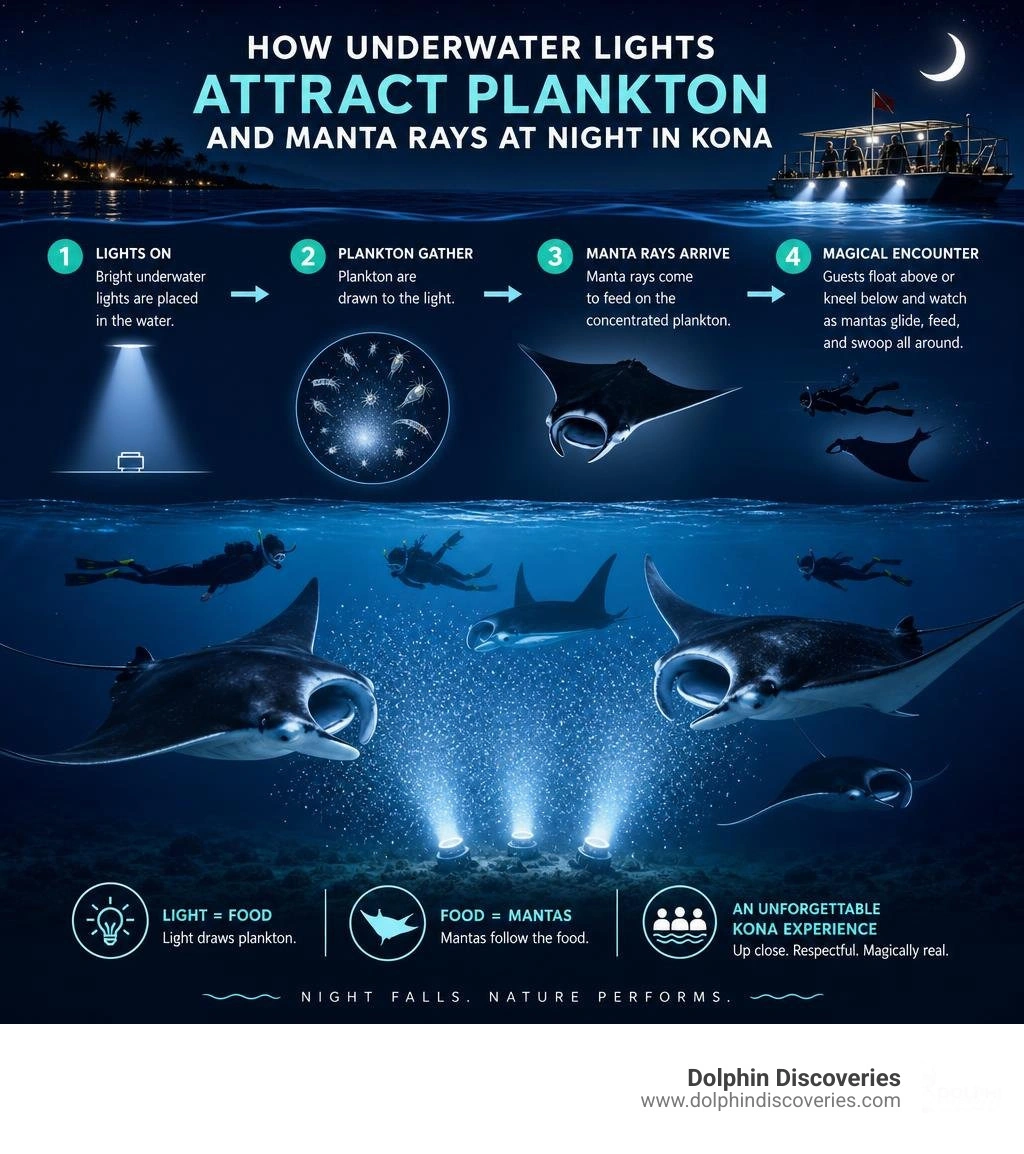
The entire experience relies on a fascinating biological chain reaction. In the wild, manta rays typically feed at night when plankton rises from the deep ocean to the surface. However, we have found a way to create a reliable, concentrated feeding ground using nothing but light.
The process follows a simple, natural sequence:
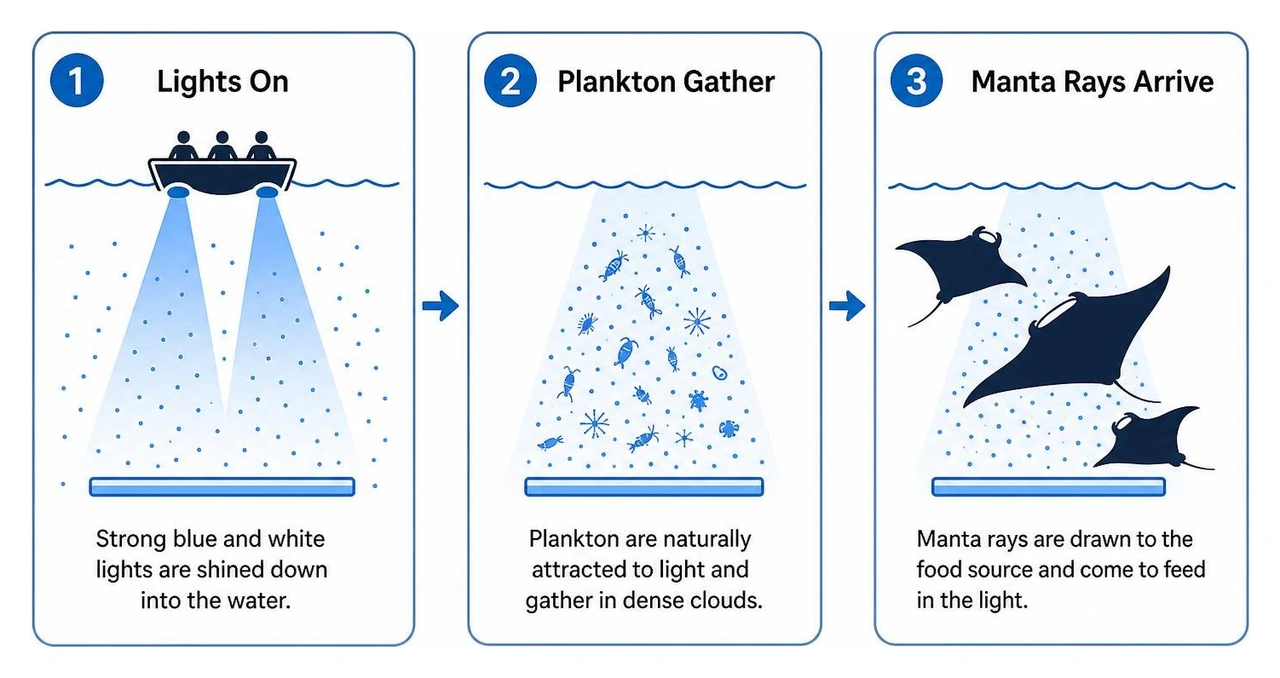
- Light Emission: Tour boats and snorkelers project strong, high-powered blue and white lights down into the water column.
- Phototaxis: Plankton, which are naturally attracted to light (a behavior called phototaxis), gather in dense, swirling clouds around the light beams.
- The Dinner Bell: Sensing this massive concentration of food, local manta rays arrive to feast.
This setup creates what the local ocean community calls the "campfire effect." Just as humans gather around a campfire, the manta rays gather around our light boards to feed.
When feeding, mantas perform a mesmerizing maneuver called a "barrel roll." They swim straight toward the light, open their cavernous mouths wide, and use their paddle-like cephalic fins to scoop plankton inside. At the last second, they execute a graceful backward somersault, looping repeatedly right beneath the surface. It is a highly coordinated, athletic dance that brings them close enough to brush past our floating platforms.
Snorkeling the Magic: The Best Way to Witness Manta Rays
While certified scuba divers sit on the sandy seafloor looking up, snorkeling from the surface is widely considered the absolute best way to experience the magic of Kona's manta rays.
Floating at the surface offers several distinct advantages:
- Unobstructed Views: Because manta rays loop upward to feed on the plankton concentrated directly beneath our light boards, snorkelers get a front-row, face-to-fin view of their white bellies and feeding sweeps.
- Ease and Accessibility: Snorkeling requires no specialized dive certifications, heavy gear, or previous night diving experience. It is highly accessible for families, seniors, and kids alike.
- Less Task Loading: Without having to manage buoyancy, air consumption, or heavy tanks, you can simply relax, hold onto our custom-designed light board, and focus entirely on the incredible wildlife performance unfolding below you.
By joining our Manta Ray Night Snorkel Kona Tour, you get to experience this breathtaking natural spectacle in a safe, small-group setting led by expert marine naturalists.
Comparing Kona’s Iconic Manta Sites: Manta Village vs. Manta Heaven
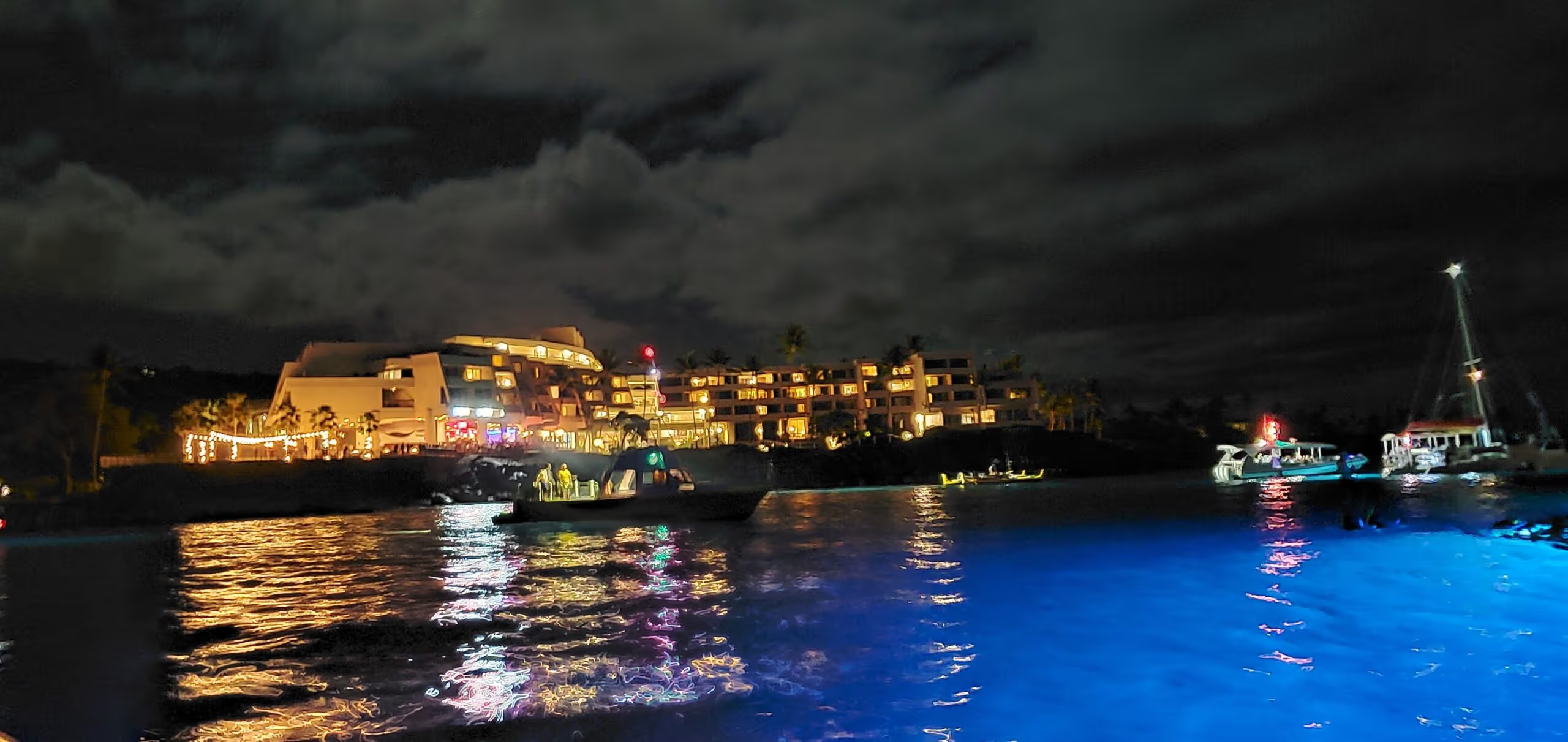
When booking your manta night dive kona adventure, you will hear about two primary viewing locations along the Kona Coast: Manta Village and Manta Heaven. While both sites offer the chance to see these majestic animals, they differ significantly in depth, conditions, and accessibility.
Depending on ocean swell and weather patterns, operators choose between these two legendary arenas to ensure the safest and most active encounter possible.
| Feature | Manta Village (Keauhou Bay) | Manta Heaven (Garden Eel Cove) |
|---|---|---|
| Location | Keauhou Bay (South Kona) | Makako Bay (North Kona) |
| Average Depth | 25 to 35 feet | 40 to 50 feet |
| Swell Protection | Highly sheltered, calm waters | Slightly more exposed to open ocean swells |
| Boat Travel Time | 5 to 10 minutes from Keauhou Harbor | 20 to 30 minutes from Honokohau Harbor |
| Best For | Families, beginners, and small-group tours | Experienced divers and northern-based charters |
Manta Village (Keauhou Bay)
Manta Village, located just outside Keauhou Bay, is the historic birthplace of the Kona manta ray night dive. In the early 1990s, the nearby Sheraton Kona Resort & Spa (now the Outrigger Kona Resort) began shining bright floodlights over the water to illuminate the rocky shoreline. Guests soon noticed massive, dark shapes gliding through the illuminated surf. Local boat captains quickly realized that the resort's lights were attracting massive clouds of plankton, drawing the local manta population right to the shallow reef.
To this day, Manta Village remains the most consistent and accessible site on the island. Because it is highly sheltered, the water is typically calmer and warmer than northern sites. Best of all, our small-group boat tours depart directly from Keauhou Bay, meaning you only have to endure a quick, comfortable 5-minute boat ride before you are in the water with the mantas. You can read more about this historic bay's connection to these gentle giants on the Manta ray snorkeling in Kona near Keauhou Bay activity page.
Manta Heaven (Garden Eel Cove)
Located further north near the Kona International Airport, Manta Heaven (also known as Garden Eel Cove in Makako Bay) is a deeper, more dramatic underwater amphitheater. This site features a sandy bottom at about 40 to 50 feet, surrounded by steep volcanic finger reefs.
Because Manta Heaven is located further offshore, it is subject to stronger coastal currents and open ocean swells. While it is a fantastic site that often hosts highly active manta feeding sessions, the longer boat rides (typically 25 to 30 minutes) and deeper, more exposed waters make it slightly more challenging for younger children or those prone to seasickness.
No matter which site you visit, the viewing mechanics remain the same: high-powered lights draw the plankton, and the plankton draws the mantas. If you want to secure your spot at the best site for the evening, check out our Manta Ray Night Snorkel Kona Tour to book your ocean adventure.
Essential Prerequisites and Safety Rules for Your Night Encounter
Floating in the pitch-black Pacific Ocean at night might sound intimidating at first, but with professional guides and strict safety protocols, it is incredibly safe and peaceful. Before jumping in, all guests receive a thorough safety briefing on deck.
The most important prerequisite for snorkeling with manta rays is basic swimming ability and comfort in open water. While we provide high-quality flotation swim vests, pool noodles, and custom-designed light boards to keep you effortlessly afloat, you must be comfortable breathing through a snorkel in water where you cannot touch the bottom.
To learn more about what to expect during your first night in the water, check out our guide on how to Discover an Underwater World on the Best Manta Ray Night Dives in Kona.
Guidelines for a Responsible Manta Night Snorkel Kona Encounter
Because manta rays are wild, sensitive animals, the local Kona ocean community has established strict, non-invasive guidelines to protect them. These rules ensure that our presence does not disrupt their natural feeding patterns or cause physical harm.
The golden rule of the manta night dive kona experience is passive interaction. We do not chase, swim after, or try to ride the mantas. Instead, we remain completely still at the surface and let the mantas control the interaction.
To understand why this is so critical, read our Manta Ray Night Dive Kona Blog for a deep dive into manta behavior.
Here are the essential rules of etiquette that every snorkeler must follow:
- Never Touch the Mantas: Manta rays have a delicate, protective mucus layer (slime coat) on their skin that shields them from marine bacteria, infections, and parasites. Touching them removes this barrier, leaving them highly vulnerable to disease.
- Keep Your Legs Horizontal: Snorkelers must keep their body completely flat and horizontal at the surface of the water. Letting your legs dangle vertically can block the path of a feeding manta or cause you to accidentally kick them as they loop upward.
- Proper Light Positioning: Always point your light source straight down into the water column. Never shine white lights directly into a manta's eyes, as this can temporarily blind or disorient them.
- Respect State and Federal Protections: Manta rays are legally protected in the state of Hawaii under Act 092 (passed in 2009), making it illegal to capture, kill, or harm them in state waters. They are also listed under CITES Appendix II to protect them from international trade.
By practicing quiet, still observation, you actually encourage the mantas to come closer. When they realize we are not a threat, they will glide so close to the light boards that you can feel the gentle wash of water from their massive wings.
Planning Your Trip: Best Times, Packing, and Sighting Guarantees
Planning ahead is the key to an unforgettable night on the water. While the manta night dive kona is a year-round attraction, understanding the seasonal nuances of the Big Island's waters will help you prepare for the best possible experience.
To get a sense of the sheer magic and excitement of this adventure, read our article to Experience the Thrill of a Night Dive with a Kona Manta Ray.
What to Pack for a Night on the Water
Even though Hawaii is a tropical paradise, the ocean air gets surprisingly chilly once the sun goes down, especially after you have spent an hour floating in 75°F to 80°F (24°C to 27°C) water.
To stay comfortable, we recommend packing the following essentials:
- Swimwear: Wear your swimsuit under your clothes to the harbor to make boarding and gearing up as quick and seamless as possible.
- Warm Layers: Bring a windproof jacket, a cozy hoodie, or a dry change of warm clothes for the boat ride back to the harbor.
- Dry Towel: A large, dry towel is essential for drying off immediately after exiting the water.
- Reef-Safe Sunscreen: If you are joining an afternoon-to-sunset charter, protect the reefs by using only non-aerosol, mineral-based sunscreens that do not contain oxybenzone or octinoxate.
- Motion Sickness Medication: If you are prone to seasickness, we highly recommend taking a preventative remedy (like Dramamine) at least an hour before boarding the boat. Floating at the surface in the dark while looking down can occasionally trigger mild motion sickness.
- Underwater Camera: A GoPro or waterproof camera securely tethered to your wrist is perfect for capturing the action. Just remember to keep it close to your body so it doesn't interfere with the mantas' flight paths.
Sighting Rates and the "No Manta" Policy
Because manta rays are wild, free-roaming animals, their presence can never be 100% guaranteed. However, thanks to the rich upwelling of nutrients along the Kona Coast, our sighting success rate is incredibly high — consistently hovering between 80% and 90% year-round.
On the rare nights when the plankton is sparse and the mantas choose to feed elsewhere, most reputable operators offer a "no-manta guarantee." While refunds are generally not provided for wild wildlife excursions, we will invite you to join us again on another night of your trip for free or a heavily discounted rate, subject to boat availability. For this reason, we always recommend scheduling your manta snorkel early in your Big Island vacation so you have plenty of flexibility to reschedule if needed.
Frequently Asked Questions About Kona Manta Tours
Is the manta ray night snorkel safe for beginners?
Yes! In fact, snorkeling with manta rays is one of the safest and most controlled open-ocean activities you can do in Hawaii. Because you remain completely stationary at the surface while holding onto a highly buoyant, illuminated light board, you do not need to worry about navigating, swimming against currents, or getting separated from the group. Our professional, lifeguard-certified guides are in the water with you the entire time to assist with flotation, adjust your gear, and ensure you feel completely safe and comfortable.
How deep is the water and how long does the tour last?
At Manta Village (Keauhou Bay), the water depth typically ranges from 25 to 35 feet, while northern sites like Manta Heaven can reach depths of 40 to 50 feet. The in-water portion of the snorkel experience generally lasts between 45 and 60 minutes, which is the perfect amount of time to watch the underwater ballet without getting too chilly. The total tour duration, including the safety briefings, gear fitting, and boat rides, is usually around 1.5 to 2 hours.
Can non-swimmers participate in the manta ray night snorkel?
For safety reasons, all guests entering the water must have basic swimming skills and previous snorkeling experience. You must be able to swim to and from the boat's boarding ladder. However, if you have non-swimmers in your family, they are more than welcome to join the tour as "ride-along" passengers! Watching the glowing blue lights illuminate the dark ocean and seeing the massive wings of the manta rays break the surface from the comfort of our dry, spacious boat is an incredibly exciting experience in its own right.
Conclusion
The manta night dive kona is far more than just a popular tourist attraction — it is a humbling, bucket-list wildlife encounter that connects you directly to the raw beauty of the Pacific Ocean. Floating quietly in the dark while these gentle, 1,000-pound giants loop and glide just inches from your mask is an experience that stays with you long after you have returned to dry land.
At Dolphin Discoveries, we are proud to offer intimate, small-group manta ray night snorkel tours departing directly from the historic Keauhou Bay. By keeping our tour groups small and our boats fast, we ensure a highly personalized, comfortable, and deeply respectful encounter with Kona's resident mantas.
Ready to experience this breathtaking underwater ballet for yourself? Book your Manta Ray Night Snorkel Kona Tour with us today, and let us show you the magic of the Kona Coast after dark!