

Why Kailua-Kona Belongs on Every Hawaii Itinerary
The best things to do in Kailua-Kona range from floating above giant manta rays at night to sipping fresh-roasted coffee on a volcanic hillside — and most of it is within easy reach of downtown.
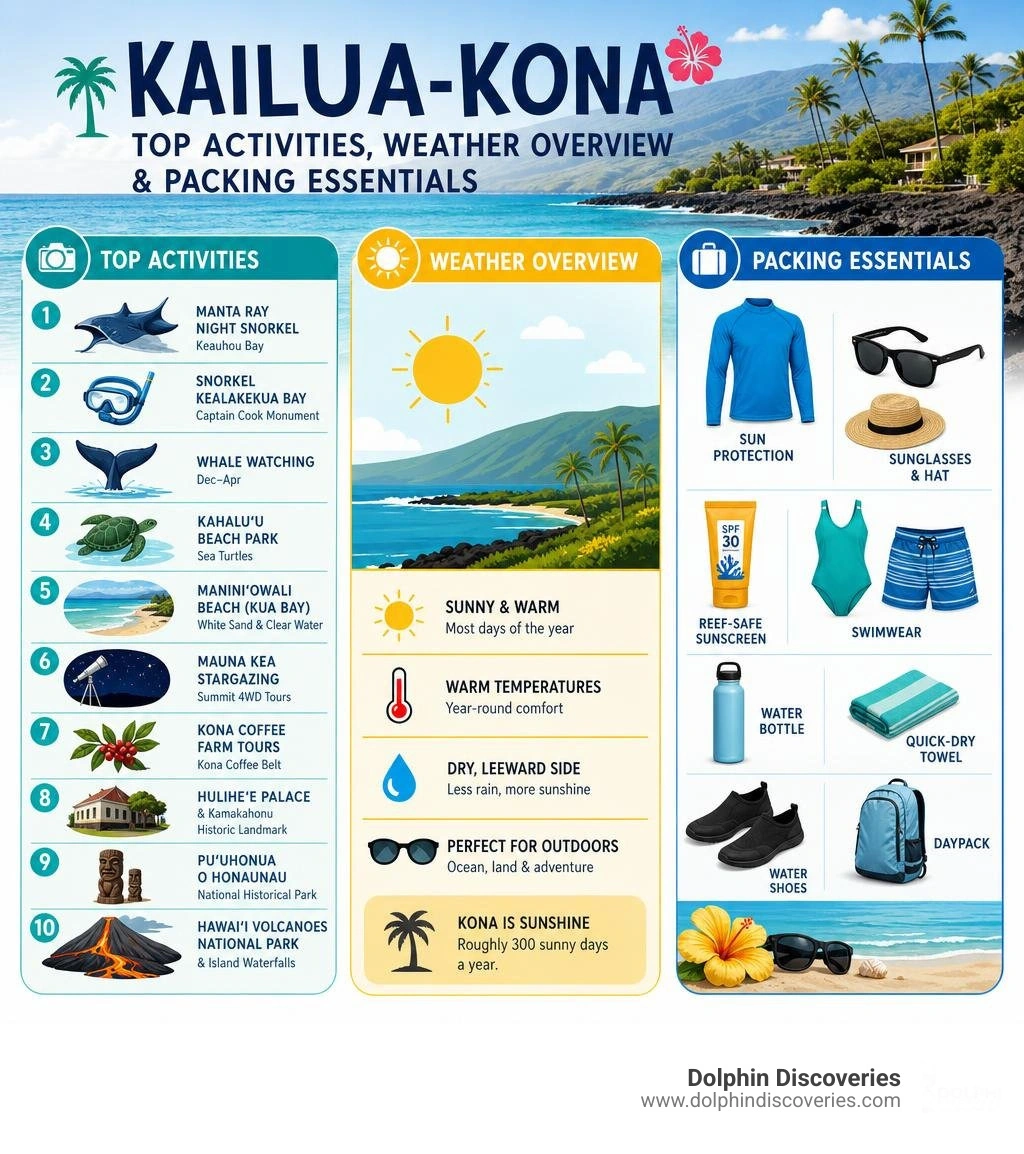
Here is a quick look at the top experiences:
- Manta ray night snorkel at Keauhou Bay (4.8/5 rating, 1,002+ reviews)
- Snorkeling Kealakekua Bay and the Captain Cook Monument
- Whale watching (December through April) and dolphin encounters
- Kahalu'u Beach Park for beginner snorkeling with sea turtles
- Manini'owali Beach (Kua Bay) for white sand and clear water (4.7/5, 1,443+ reviews)
- Mauna Kea stargazing and summit 4WD tours (4.7/5, 4,640+ reviews)
- Kona coffee farm tours along the famous Coffee Belt
- Hulihe'e Palace and Kamakahonu historic landmark downtown
- Pu'uhonua o Honaunau National Historical Park (Place of Refuge)
- Day trips to Hawaii Volcanoes National Park and island waterfalls
Kailua-Kona sits on the dry, leeward side of Hawaii Island. It gets roughly 300 sunny days a year. That makes it the most reliably good base for outdoor and ocean activities on the Big Island.
Unlike resort corridors to the north or the rainier east side near Hilo, Kona has a genuine local vibe. You can walk Ali'i Drive in the morning, snorkel a marine sanctuary by afternoon, and watch manta rays feed after dark — all without a complicated plan.
This guide covers everything worth doing, whether you have three days or a full week.
Unforgettable Things to Do in Kailua-Kona on the Water
The Kona Coast is famous for having some of the calmest, clearest, and most biologically diverse waters in the Hawaiian archipelago. Because the massive volcanic peaks of Mauna Loa and Hualalai block the trade winds, the sea here behaves more like a giant saltwater swimming pool than an open ocean.
If you are planning your aquatic adventures, starting with a guided ocean tour from Keauhou Bay is the absolute best way to experience this vibrant marine life. To get your bearings on the best spots, check out our comprehensive guide to Kailua Kona Snorkeling as well as the highly detailed Kailua-Kona Travel Guide: Beaches, Activities & Local Tips (2026) to ensure you don't miss a thing.
Manta Ray Night Snorkel: One of the Best Things to Do in Kailua-Kona at Night
If you only do one organized ocean excursion during your time on the Big Island, make it this one. It is widely considered one of the most spectacular, bucket-list wildlife encounters on Earth.

Unlike other ocean adventures, this experience begins just as the sun dips below the horizon. We set out on our fast, comfortable boats from Keauhou Bay to the nearby feeding grounds. Powerful underwater lights are shone into the water, which instantly attracts clouds of microscopic plankton. The local manta rays — gentle giants with wingspans reaching anywhere from 8 to 16 feet — arrive to feed on the concentrated plankton.
They glide, loop, and somersault just inches below the surface, often coming close enough to show off their unique belly markings. Because manta rays have no stingers, barbs, or teeth, they are completely harmless to humans.
This activity is incredibly popular, as reflected by the general consensus of over 1,002 reviews with a 4.8 rating for Kona manta ray night snorkels. To secure your spot on our intimate, small-group, naturalist-led tour, we highly recommend booking your Manta Ray Night Snorkel Kona well in advance, especially during the busy summer and winter travel seasons.
Snorkeling Kealakekua Bay and the Captain Cook Monument
Located about 12 miles south of downtown Kailua-Kona, Kealakekua Bay is a pristine Marine Life Conservation District that offers some of the best underwater visibility in the entire state. The bay is historically significant as the site where British explorer Captain James Cook first made contact with the island in 1779, and where he was subsequently killed. Today, a white stone obelisk stands on the remote northern shoreline to mark the event.
Because the bay is heavily protected, the coral reefs here are exceptionally healthy, hosting over 400 species of tropical fish, green sea turtles, and vibrant coral gardens. The water is so calm and clear that visibility regularly exceeds 100 feet.
Accessing the monument by land requires a strenuous, hot 3.5-mile round-trip hike with a grueling 1,300-foot elevation change on the return leg. The most relaxing and enjoyable way to experience this underwater paradise is by boat. Our Captain Cook Snorkel Tour takes you directly to the monument’s best reef zones, bypassing the exhausting hike entirely. For more details on why this spot stands out, check out our review of The 3 Best Snorkeling Spots in Kona.
Whale Watching and Ethical Dolphin Encounters
Kona’s waters are also home to a spectacular array of marine mammals. From mid-December through April, over 8,000 humpback whales migrate from their icy feeding grounds in Alaska to the warm, shallow waters of Hawaii to mate, give birth, and raise their calves.
Our seasonal Whale Watching Kailua Kona tours offer an up-close look at these majestic creatures as they breach, tail-slap, and blow. Led by our expert naturalists on fast, small-group boats, you will learn about whale behavior and even listen to their complex songs using our onboard hydrophones.
In addition to seasonal whales, resident pods of Hawaiian spinner dolphins can be seen in Kona’s bays year-round. These highly social animals are famous for their acrobatic leaps, flips, and spins.
We take ethical wildlife viewing very seriously. In accordance with federal law, it is strictly illegal to swim with or closely approach spinner dolphins to ensure they get the rest they need during the day. Our tours focus on respectful, non-intrusive observation from a safe distance, allowing you to appreciate these incredible animals without disrupting their natural behaviors.
Sun, Sand, and Surf: The Best Beaches in Kona
No trip to Kailua-Kona is complete without spending some quality time on its diverse beaches. From pocket-sized coves with ancient lava formations to wide stretches of powdery white sand, there is a shoreline here for every mood.
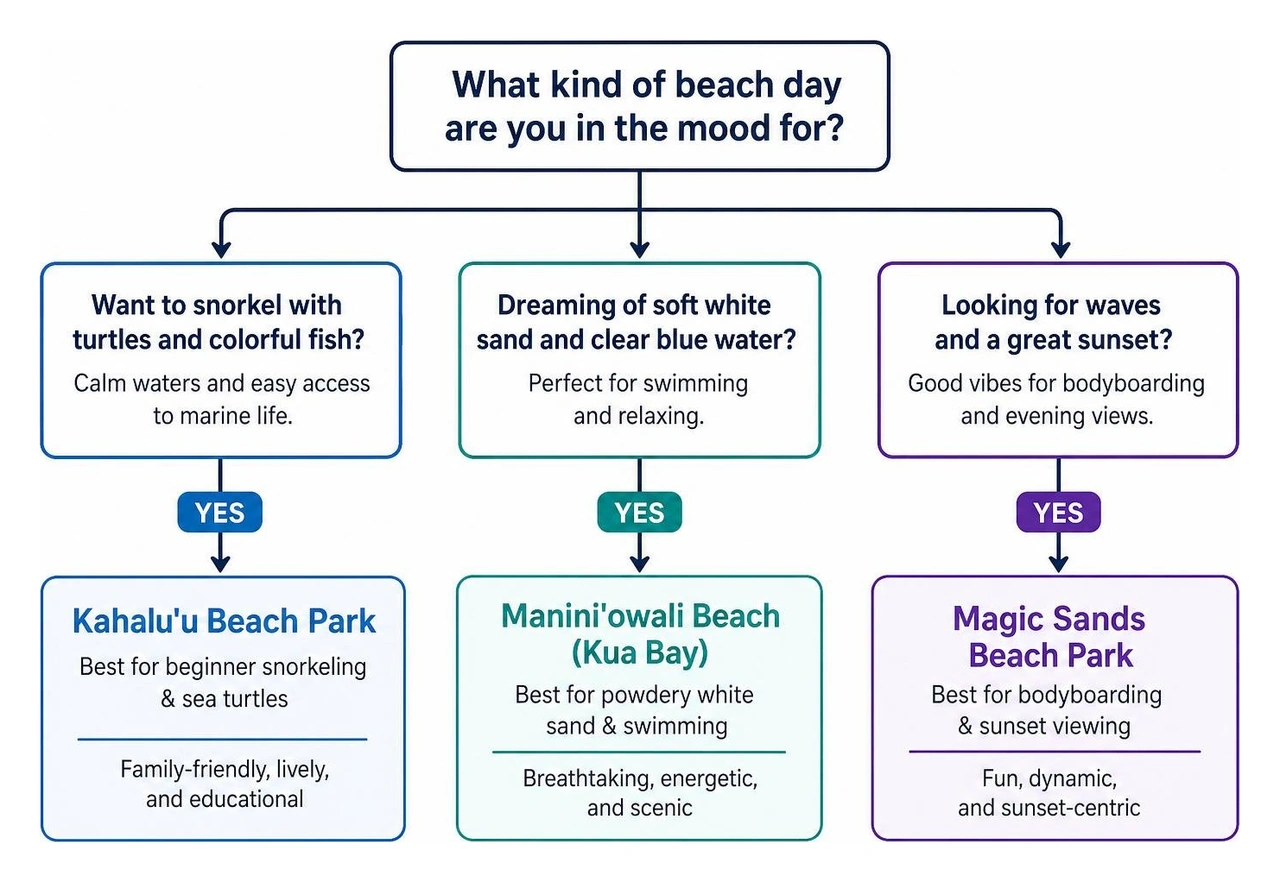
To help you choose your perfect beach day, we have put together a quick comparison of the three most popular spots near town. For a deeper dive into the island's best coastal spots, explore our guide to the Best Snorkeling Hawaii.
| Beach Name | Best For | Facilities | Vibe |
|---|---|---|---|
| Kahalu'u Beach Park | Beginner snorkeling & sea turtles | Restrooms, showers, lifeguards, picnic tables | Family-friendly, lively, and educational |
| Manini'owali Beach (Kua Bay) | Powdery white sand & swimming | Restrooms, showers, limited parking | Breathtaking, energetic, and scenic |
| Magic Sands Beach Park | Bodyboarding & sunset viewing | Restrooms, showers, lifeguards, nearby dining | Fun, dynamic, and sunset-centric |
To make your choice even easier, you can follow this simple decision path:
Kahalu'u Beach Park for Beginner Snorkeling
If you want to see Hawaiian green sea turtles (known locally as honu) and schools of colorful reef fish without venturing far from shore, Kahalu'u Beach Park is your best bet. Located just five miles south of downtown Kona, this shallow, lava-rimmed bay is incredibly sheltered, making it perfect for kids and first-time snorkelers.
The reef here is teeming with life, including yellow tangs, parrotfish, and critical coral structures. Because the entry can be quite rocky and sharp, wearing sturdy water shoes is highly recommended to protect your feet.
Always remember to maintain a respectful distance of at least 10 feet from the sea turtles, both in the water and when they are resting on the rocks. For more tips on making the most of your underwater visit here, read our guide to Kona Snorkeling.
Manini'owali Beach (Kua Bay) for Pure Relaxation
Located about 30 minutes north of downtown Kailua-Kona, Manini'owali Beach at Kua Bay is a postcard-perfect crescent of fine white sand set against a stark backdrop of black lava rock. The contrast of the dark lava, bright sand, and brilliant turquoise water is absolutely stunning.
This beach has earned rave reviews from travelers worldwide, boasting a 4.7/5 rating across 1,443 reviews on popular travel platforms. It is the ultimate place to spread out a towel, read a book, and soak up the sun.
The water here is incredibly clear and inviting, making it a favorite spot for swimming when the ocean is calm. However, because there is very little shade, you will want to pack plenty of reef-safe sunscreen, water, and perhaps a beach umbrella.
Parking can fill up rapidly on weekends, so arriving before 9:00 AM or after 3:00 PM is highly recommended. To see how Kua Bay fits into a broader list of island attractions, check out THE 30 BEST Things to Do in Kailua-Kona (2026) .
Magic Sands Beach Park for Bodyboarding and Sunsets
Magic Sands Beach Park (also known as La'aloa Bay) is a lively pocket of sand located right along Ali'i Drive. It gets its "magical" name from a unique natural phenomenon: during big winter swells, the powerful surf washes all the sand away, exposing the underlying black lava rock. When the calmer summer currents return, the sand is gently redeposited, magically recreating the beach.
With over 1,359 reviews and a 4.2 rating, Magic Sands is a popular hub for bodyboarding, beach volleyball, and sunbathing. The shorebreak here can be very strong and playful, which is fantastic for experienced bodyboarders but requires caution for casual swimmers.
It is also one of the premier spots in Kona to sit on the sand with a cool drink and watch the sun melt into the Pacific Ocean.
Cultural Landmarks and Historic Sites
Beyond its natural beauty, Kailua-Kona holds a deep and storied place in Hawaiian history. It served as the first capital of the unified Kingdom of Hawaii under King Kamehameha I, and later became a favored vacation retreat for Hawaiian royalty.
Strolling along historic Ali'i Drive is like walking through an open-air museum. This scenic coastal road features several landmarks within easy walking distance of one another.
To help you plan your historical walking tour, here is a list of the top cultural sites in and around downtown Kona:
- Hulihe'e Palace: Former vacation home for Hawaiian monarchs
- Mokuaikaua Church: The oldest Christian church in the state of Hawaii
- Kamakahonu National Historic Landmark: The final residence of King Kamehameha I
- Kaloko-Honokohau National Historical Park: Ancient fishponds and petroglyphs
- Pu'uhonua o Honaunau National Historical Park: A sacred place of refuge
Ali'i Drive itself is highly rated, with 953 reviews and a 4.2 rating, making it a must-visit stretch for history buffs and casual strollers alike. For a complete look at these downtown treasures, explore Top Things To Do In Kona - Must See Attractions .
Hulihe'e Palace and Kamakahonu National Historic Landmark
Located right in the heart of downtown Kailua-Kona, Hulihe'e Palace was built in 1838 out of lava rock, coral mortar, and native koa wood. It served as a grand summer residence for Hawaiian royalty, including King Kalakaua and Queen Kapi'olani. Today, the palace operates as a fascinating museum showcasing a beautiful collection of ancient Hawaiian artifacts, royal portraits, and magnificent monarch-era furniture.
Just a short walk away, on the quiet beach next to the King Kamehameha Kona Beach Resort, lies Kamakahonu National Historic Landmark. This was the final home and estate of King Kamehameha I, who united the Hawaiian Islands under his rule. Here, you can view the reconstructed Ahu'ena Heiau, a sacred temple that served as his personal sanctuary and political headquarters.
Directly across the street is Mokuaikaua Church. Completed in 1837, it is the oldest Christian church in Hawaii, constructed using stones salvaged from an ancient heiau mixed with burnt coral mortar.
Kaloko-Honokohau National Historical Park
Located just north of town, Kaloko-Honokohau National Historical Park offers a fascinating window into how early Hawaiians survived and thrived in this rugged volcanic landscape. The park features impressive coastal trails, ancient petroglyph carvings, and massive stone fishponds (Aimakapa and Kaloko) that demonstrate advanced early engineering.
With 851 reviews and a 4.5 rating, this national historical park is a fantastic, crowd-free place to hike. Green sea turtles frequently haul themselves onto the sandy shores of Honokohau Beach to bask in the sun, and native waterbirds can often be spotted in the brackish wetlands.
Be sure to stop by the visitor center to pick up a trail map and learn about the park’s unique coastal ecology.
Pu'uhonua o Honaunau National Historical Park
Located about 20 miles south of Kona, Pu'uhonua o Honaunau (the Place of Refuge) is one of the most sacred cultural sites in all of Hawaii. In ancient times, if a citizen broke a sacred law (kapu), the penalty was death. However, if they could elude their pursuers and reach this sacred sanctuary, they would be absolved of their sins by a priest and spared.
The park features a massive, 1,000-foot-long Great Wall built entirely without mortar, towering wooden tiki statues (ki'i) guarding a sacred royal mausoleum, and peaceful coastal paths lined with coconut palms.
National Park rangers host regular cultural talks that bring the history, legends, and spiritual significance of this incredible sanctuary to life.
Land Adventures: Coffee Farms, Volcanoes, and Mountain Summits
While the ocean is Kona's main attraction, the land adventures on the Big Island are equally dramatic. The island's immense size and volcanic topography mean you can travel from sea level to nearly 14,000 feet in a single afternoon, or hike across still-steaming lava fields.
To help you structure these diverse inland excursions, check out The Best Kona Itinerary: 3 Days in Kona, Hawaii for practical planning tips.
Exploring Coffee Farms: Delicious Things to Do in Kailua-Kona for Foodies
The volcanic slopes of Hualalai and Mauna Loa provide the perfect microclimate for growing coffee: mineral-rich soil, sunny mornings, afternoon cloud cover, and gentle evening breezes. This narrow strip of land is known as the Kona Coffee Belt, and it produces some of the most sought-after (and expensive) single-origin coffee in the world.

Taking a drive along the scenic Mamalahoa Highway through the artistic village of Holualoa is a fantastic way to spend an afternoon. Many historic family-owned farms offer free walking tours and tastings, allowing you to see how the coffee "cherries" are harvested, pulped, dried, and roasted.
If you want to diversify your agricultural tour, consider stopping by The Vanillerie, a lovely local farm specializing in growing organic vanilla beans (boasting an impressive 4.9/5 rating across 833 reviews). Another unique stop is the Ocean Rider Seahorse Farm near the airport, which holds a 4.5/5 rating with 1,153 reviews and offers educational tours focused on marine conservation.
Stargazing and 4WD Excursions on Mauna Kea
Rising 13,803 feet above sea level (and over 33,000 feet from its underwater base), Mauna Kea is the highest point in Hawaii and the tallest sea mountain on Earth. Because of its extreme altitude, dry air, and lack of light pollution, it is also home to one of the world's premier astronomical observatories.
A trip to the Mauna Kea Summit is an unforgettable experience, as reflected by its 4,640 reviews and 4.7 rating. You can drive a 4WD vehicle to the summit to watch a spectacular sunset above the clouds, then descend to the Visitor Information Station at 9,200 feet for world-class stargazing.
Because of the extreme elevation change and freezing temperatures, it is vital to acclimate at the visitor center for at least 30 minutes, wear heavy winter layers, and ensure your rental car agreement permits driving on the steep, unpaved summit road.
Day Trips to Hawaii Volcanoes National Park and Waterfalls
While Kailua-Kona is dry and sunny, the windward side of the island is a lush, rain-carved paradise. A day trip to Hawaii Volcanoes National Park allows you to witness the raw power of creation at Kilauea, one of the world's most active volcanoes.
You can walk through the massive Nahuku (Thurston) Lava Tube, hike across the still-steaming floor of the Kilauea Iki Crater, and view the active volcanic vents.
On your way back, stop by the historic town of Hilo to view the iconic 80-foot Rainbow Falls or hike the short loop trail to the spectacular 442-foot Akaka Falls.
If you prefer to leave the driving and logistics to the experts, booking a guided "Big Island in a Day" tour (which carries a 4.9 rating across 3,189 reviews) is a highly efficient way to see these natural wonders without the stress of planning a long road trip.
Frequently Asked Questions about Kailua-Kona
To help you finalize your travel plans, we have compiled answers to some of the most common questions visitors ask when planning their trip to the Kona Coast. For more detailed practical tips, explore our comprehensive FAQ page.
What is the best month to visit Kailua-Kona?
Kailua-Kona is a fantastic year-round destination, but the "best" time to visit depends on what you want to experience:
- For Whale Watching: January through March is the peak of the humpback whale migration season, offering the most frequent sightings.
- For Great Deals & Fewer Crowds: The shoulder seasons of April through May and September through October offer gorgeous weather, calm ocean conditions, and lower rates on accommodations.
- For Calmest Snorkeling: The summer months of June through August bring exceptionally warm, glassy ocean conditions, which are ideal for exploring the coral reefs.
Do you need a rental car to get around Kona?
While downtown Kailua-Kona is highly walkable, we strongly recommend renting a car for your trip. The Big Island is incredibly vast, and public transportation is limited.
Having a vehicle gives you the freedom to explore remote white sand beaches, visit high-elevation coffee farms, and take day trips to the volcanoes or Hilo.
- Parking Tip: Parking in downtown Kona can be competitive on weekends. Look for the public lot near the pier or arrive early to secure street parking along Ali'i Drive. Always remember to fill up your gas tank in town, as stations can be sparse in rural areas of South Kona.
How many days do you need to experience Kailua-Kona?
We recommend spending at least three to four full days in the Kona area to experience the highlights without feeling rushed. This allows you enough time for a manta ray night snorkel, a day of snorkeling at Kealakekua Bay, a beach relaxation day, and an afternoon exploring historic sites and coffee farms.
If you have a week, you can easily add day trips to Volcanoes National Park, Mauna Kea, and the lush valleys of the northern coast. To help plan your time, check out our guide on the Top 10 Things to Do in Kona Hawaii.
Conclusion
Kailua-Kona is a destination where natural wonders, rich history, and laid-back island vibes come together perfectly. Whether you are floating above giant manta rays in the dark, exploring historic palaces, or simply relaxing on a pristine white sand beach, the memories you make here will last a lifetime.
At Dolphin Discoveries, we are passionate about sharing the magic of the Kona Coast with our guests. Our small-group, naturalist-led tours on fast, comfortable boats are designed to provide intimate, educational, and deeply respectful encounters with Hawaii's incredible marine life. From Keauhou Bay to the Captain Cook Monument, we focus on ethical wildlife encounters that protect these beautiful animals for generations to come.
Ready to start planning your perfect Hawaiian getaway? Book Your Kona Adventure with us today and let us show you the very best of Kailua-Kona from the water!