

Ancient Hawaiian Roots: Religious Capital and Sacred Sites
Long before European sails appeared on the horizon, Kealakekua Bay was a bustling political and religious capital on the island of Hawaiʻi. Hawaiian settlement in South Kona dates back over a thousand years. The natural geography of the bay—offering the most sheltered deep-water anchorage on the island—made it an ideal center for political power, ocean navigation, and rich agricultural production.
The bay was anchored by major coastal settlements at Kaʻawaloa on the northern arm and Napōʻopoʻo along the southern shore. Overlooking the entire bay stands Pali Kapu O Keōua ("The Sacred Cliff of Keōua"), a dramatic 600-foot vertical sea cliff. These cliffs were designated as sacred burial grounds for Hawaiian royalty (aliʻi). Because high chiefs held immense spiritual power (mana), their bones were hidden in secret caves high up the sheer cliff face to prevent desecration.
At the base of the cliffs in Napōʻopoʻo sits Hikiau Heiau, a massive stone temple platform measuring roughly 16 feet high, 250 feet long, and 100 feet wide. Hikiau was an essential luakini (sacrificial) temple dedicated to Kū, the god of war and statecraft, used by paramount chiefs to seek victory before military campaigns. During the annual Makahiki harvest festival, the temple also served as a focal point for ceremonies honoring Lono, the god of fertility, peace, and agriculture.
This dense coastal population was fed by the Kona field system—an extensive agricultural network stretching approximately 18 miles along the coast and running inland up to 2,500 feet in elevation. Families farmed sweet potatoes (ʻuala), taro (kalo), and bananas in systematic upland plots, trading their yields with coastal fishermen. To learn more about the surrounding geography, check out our guide About Kealakekua Bay.
The Complete Kealakekua Bay History: Captain Cook's Arrival and Fatal Encounter
The timeline of Kealakekua Bay history changed forever on January 17, 1779, when Captain James Cook sailed into the bay aboard HMS Resolution, accompanied by HMS Discovery. Cook had first encountered the Hawaiian Islands on Kauaʻi in 1778, but this was his first direct contact with the island of Hawaiʻi.
Cook’s arrival coincided precisely with the Makahiki festival. His ships—resembling white sails floating on the ocean—mirrored cultural traditions associated with Lono. High Chief Kalaniʻōpuʻu and the local priesthood received Cook with great honor, leading him to Hikiau Heiau for sacred rituals. During this stay, a deceased crew member named William Watman was buried near Hikiau Heiau, marking the first recorded Christian service in the Hawaiian Islands.
Tensions began to surface when the ships prepared to depart. Supplies were depleted, and friction arose when Cook's crew harvested wood from a sacred burial ground wall (morai) for firewood. The British ships sailed away on February 4, 1779, but were forced to return just days later when HMS Resolution sprung its foremast in a gale.
Upon their return, the mood had shifted. The Makahiki festival had concluded, and resources were strained. Misunderstandings quickly spiraled:
- A local chief was struck during an altercation, and Hawaiians seized a British jolly boat for its valuable iron fasteners.
- On February 14, 1779, Cook landed at Kaʻawaloa with armed marines, intending to take Chief Kalaniʻōpuʻu hostage aboard his ship until the boat was returned.
- News arrived that another high chief had been killed across the bay, enraging the gathering crowd along the Kaʻawaloa shoreline.
- A violent skirmish erupted on the beach. Captain James Cook was struck down and killed at the water's edge alongside four British marines and several Hawaiian warriors.

Following Cook's death, his officers eventually recovered portions of his body for a formal naval burial at sea within the bay. If you'd like to read more about exploring this historical turning point from the ocean, view our post Uncover Hawaii's History on a Captain Cook Boat Tour.
Cultural Exchange, Unification, and 19th-Century Transformations
Cook's visit opened the door for rapid international trade and foreign political influence across the Hawaiian Kingdom.
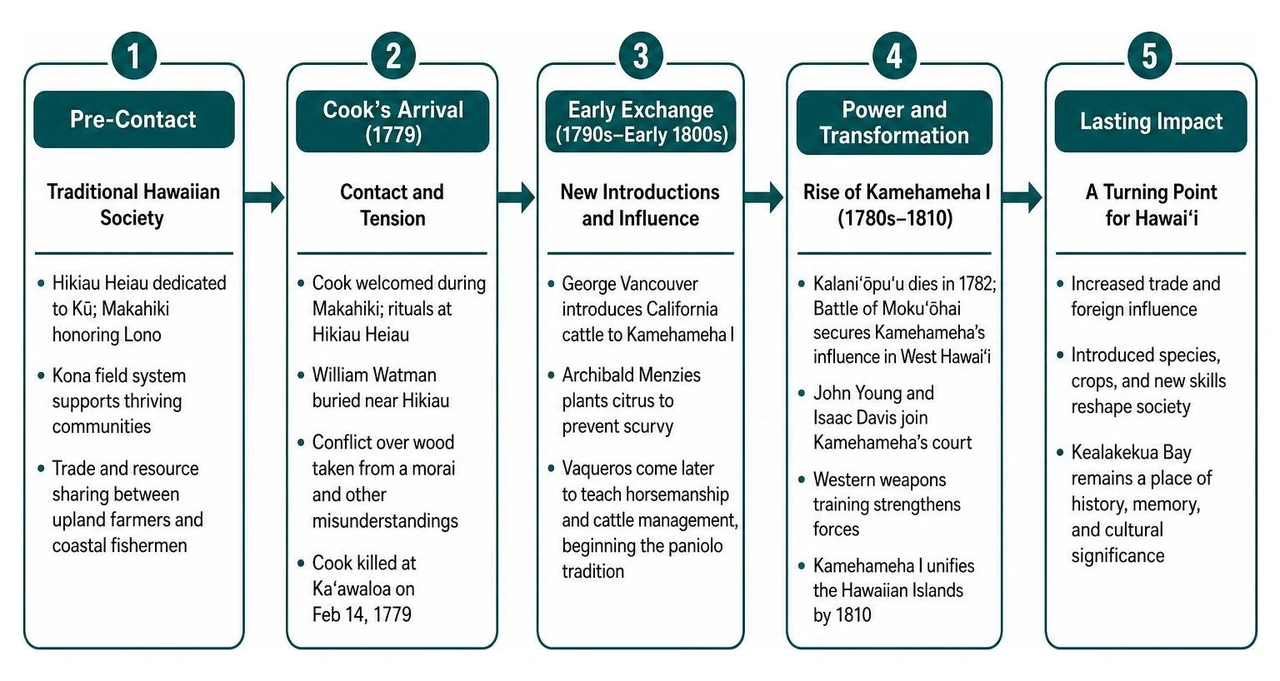
In 1793, Captain George Vancouver visited Kealakekua Bay. Vancouver introduced California cattle to King Kamehameha I. To protect the herd, Kamehameha placed a ten-year kapu (prohibition) on hunting them. The cattle quickly multiplied and turned feral in the uplands, which eventually led to bringing in Mexican-Spanish cowboys (vaqueros) in the early 19th century to teach local residents horsemanship and cattle management—founding Hawaiʻi's legendary paniolo (cowboy) tradition.
Additionally, Scottish botanist Archibald Menzies planted citrus seeds around the bay to supply future vessels with fresh fruit to prevent scurvy.
Kealakekua Bay was also pivotal in Kamehameha I’s rise to power. Following Kalaniʻōpuʻu's death in 1782, the nearby Battle of Mokuʻōhai took place, securing Kamehameha's hold over West Hawaiʻi. Kamehameha took two captured British sailors, John Young and Isaac Davis, into his inner circle. Young and Davis were given noble titles, married into royalty, and trained Kamehameha’s forces in Western artillery and musket tactics, enabling him to ultimately unify the Hawaiian Islands by 1810.
| Historical Era | Primary Economic / Political Focus | Key Cultural / Religious Features |
|---|---|---|
| Pre-Contact (Pre-1778) | Upland farming (Kona Field System) & coastal fishing | Luakini heiau rituals, Makahiki celebrations, royal cliff burials |
| Early Contact (1779–1819) | Fur trade stopover, iron bartering, firearm acquisition | Western contact, introduction of cattle, kingdom unification wars |
| Missionary & Trade (1820–1890s) | Coffee cultivation, cattle ranching, whaler trade, shipping | Abolition of kapu, Christian churches, collapse of traditional villages |
Kealakekua Bay History in the 19th Century: Missionaries and Economic Shifts
The traditional socio-religious order collapsed rapidly after King Kamehameha I died in 1819. His successor, Liholiho (Kamehameha II), alongside Queen Kaʻahumanu, abolished the ancient religious system known as the kapu system (the ʻAi Noa movement). Later that year, the Battle of Kuamoʻo was fought just north of the bay, where traditionalists attempted to defend the old religious ways but were defeated by royal forces equipped with cannons.
Changes accelerated with the arrival of American Protestant missionaries:
- Henry ʻŌpūkahaʻia: A young Hawaiian born near South Kona sailed away from Kealakekua Bay in 1809. His conversion to Christianity in New England inspired the birth of the Hawaiian Mission movement.
- Mission Establishment: In 1824, a Protestant mission was built at Napōʻopoʻo. Chiefess Kapiʻolani, an early Hawaiian Christian convert, famously defied the volcano goddess Pele at Kīlauea and worked to protect ancient royal bones by hiding them safely within the cliffs of Pali Kapu O Keōua.
- Kahikolu Church: Built near Napōʻopoʻo in the mid-19th century, this historic stone church stands as a monument to this religious shift.
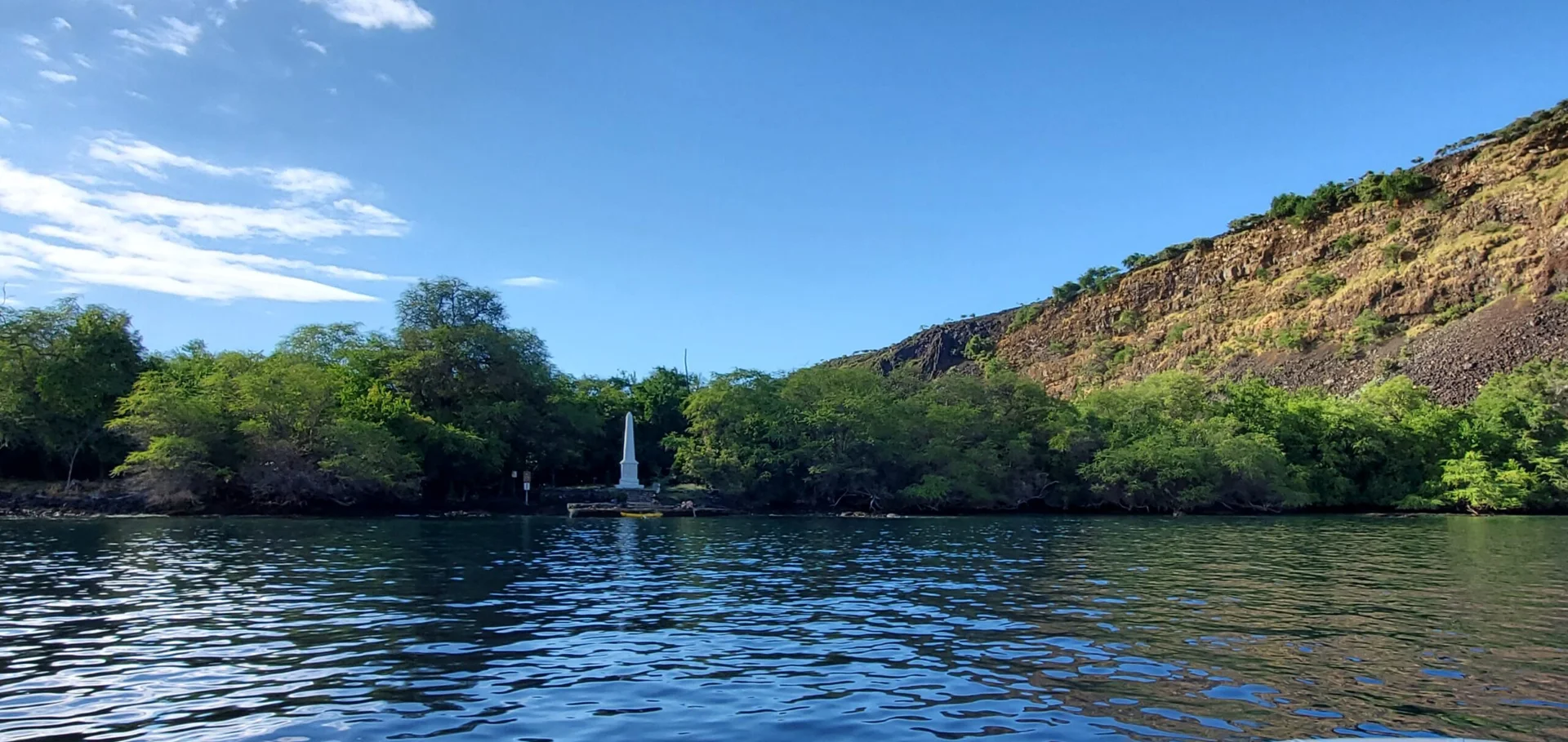
Economically, Kaʻawaloa and Napōʻopoʻo shifted from traditional farming to coffee production, cattle ranching, and trade with visiting whaling ships. Napōʻopoʻo Wharf became a shipping point for South Kona. In 1874, a 27-foot white stone obelisk—the Captain Cook Monument—was erected by British sailors at Kaʻawaloa, and the immediate surrounding plot was deeded to the United Kingdom in 1877.
In February 1877, a rare natural event occurred directly inside the bay: a short, single-day underwater eruption of Mauna Loa volcano, sending up plumes of gas, turbulent water, and floating blocks of lava. For detailed archival records regarding the region's historical register status, view the official (Type all entries — complete applicable sections) documentation.
Conservation, Heritage Sites, and Modern Visitor Access
As commercial shipping moved toward larger commercial harbors in the 20th century, Kealakekua Bay transitioned into a protected cultural and marine sanctuary.
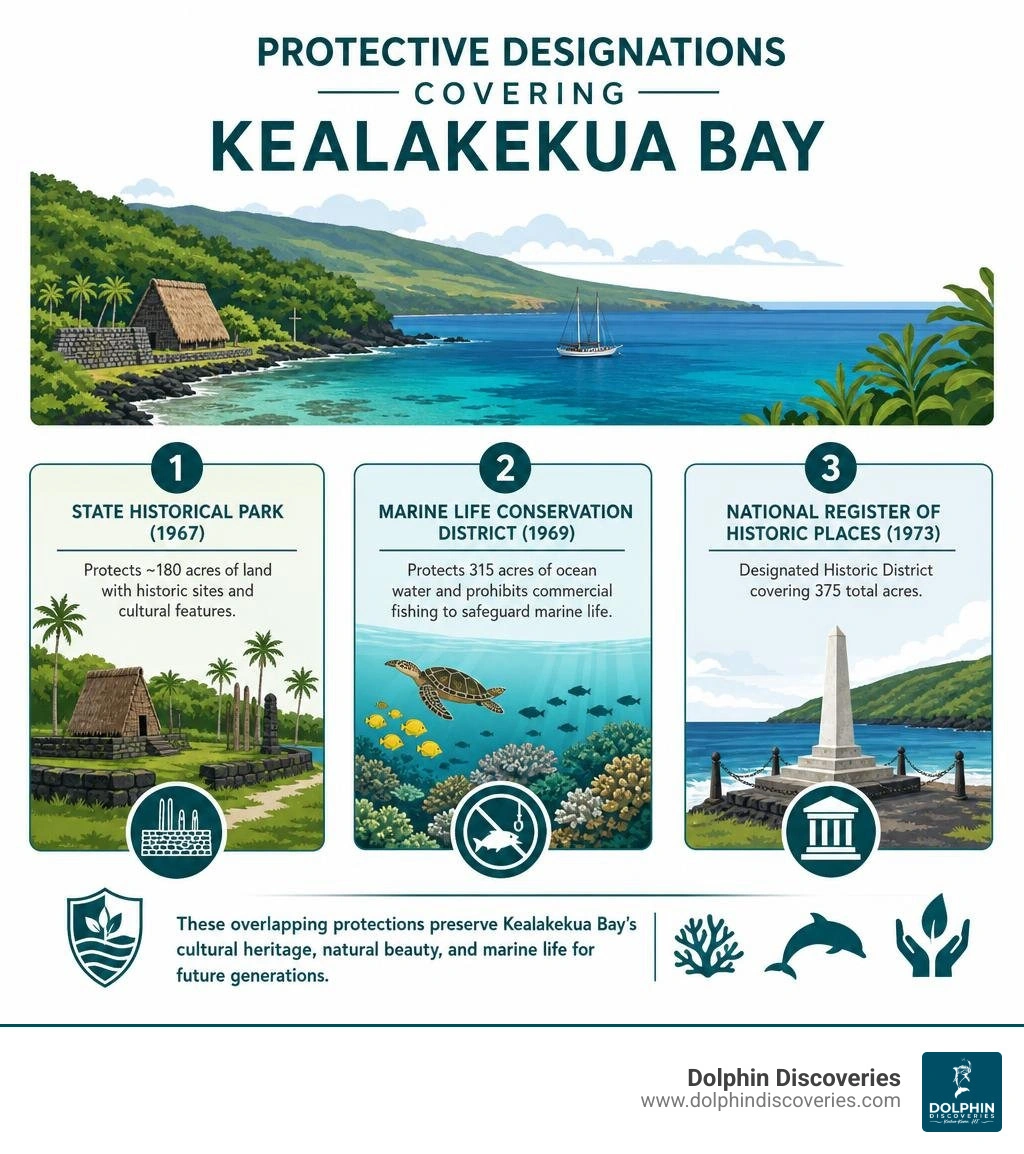
- State Historical Park (1967): Covers approximately 180 acres around the bay, protecting land structures like Hikiau Heiau and ancient residential house foundations.
- Marine Life Conservation District (1969): Encompasses 315 acres of ocean water, making it the largest sheltered natural bay on the island and banning commercial fishing to protect coral systems.
- National Register of Historic Places (1973): Listed as a Historic District spanning 375 total acres under site reference 73000651.
Today, the bay's sheltered waters host vibrant coral reefs and serve as a nursery for wild Hawaiian spinner dolphins (Stenella longirostris). State and federal laws strictly mandate that all ocean users stay at least 50 yards away from spinner dolphins to allow them to rest in peace during daylight hours.
Visitors can read official park management guidelines through the state Ruling documentation. Because there are no public roads to the remote northern shore where the obelisk stands, accessing Kaʻawaloa Cove requires planning:
- Hiking: Taking the steep Kaʻawaloa Road Trail down from Highway 11 (a strenuous 3.8-mile roundtrip walk).
- Guided Boat Tours: Joining an authorized tour operator departing from nearby harbors.
- Permitted Kayaking: Kayak landings on the shore at Kaʻawaloa require specific state landing permits.
To learn more about exploring this protected area, check out our guide on Why Captain Cook Monument Snorkeling Should Be on Your Hawaii Bucket List.
Modern Kealakekua Bay History: Protection as a Marine Preserve and State Park
Beyond its physical preservation, Kealakekua Bay occupies a special place in popular culture and literature:
- Mark Twain penned vivid descriptions of his travels around Kealakekua Bay in Chapter 71 of his 1872 book Roughing It.
- Author Arthur C. Clarke referenced the bay in his classic science fiction novel Rendezvous with Rama.
- The famous 1933 Hawaiian song "My Little Grass Shack in Kealakekua, Hawaii" brought the bay international fame while popularizing the name of Hawaiʻi's state fish: the humuhumunukunukuapuaʻa (reef triggerfish).

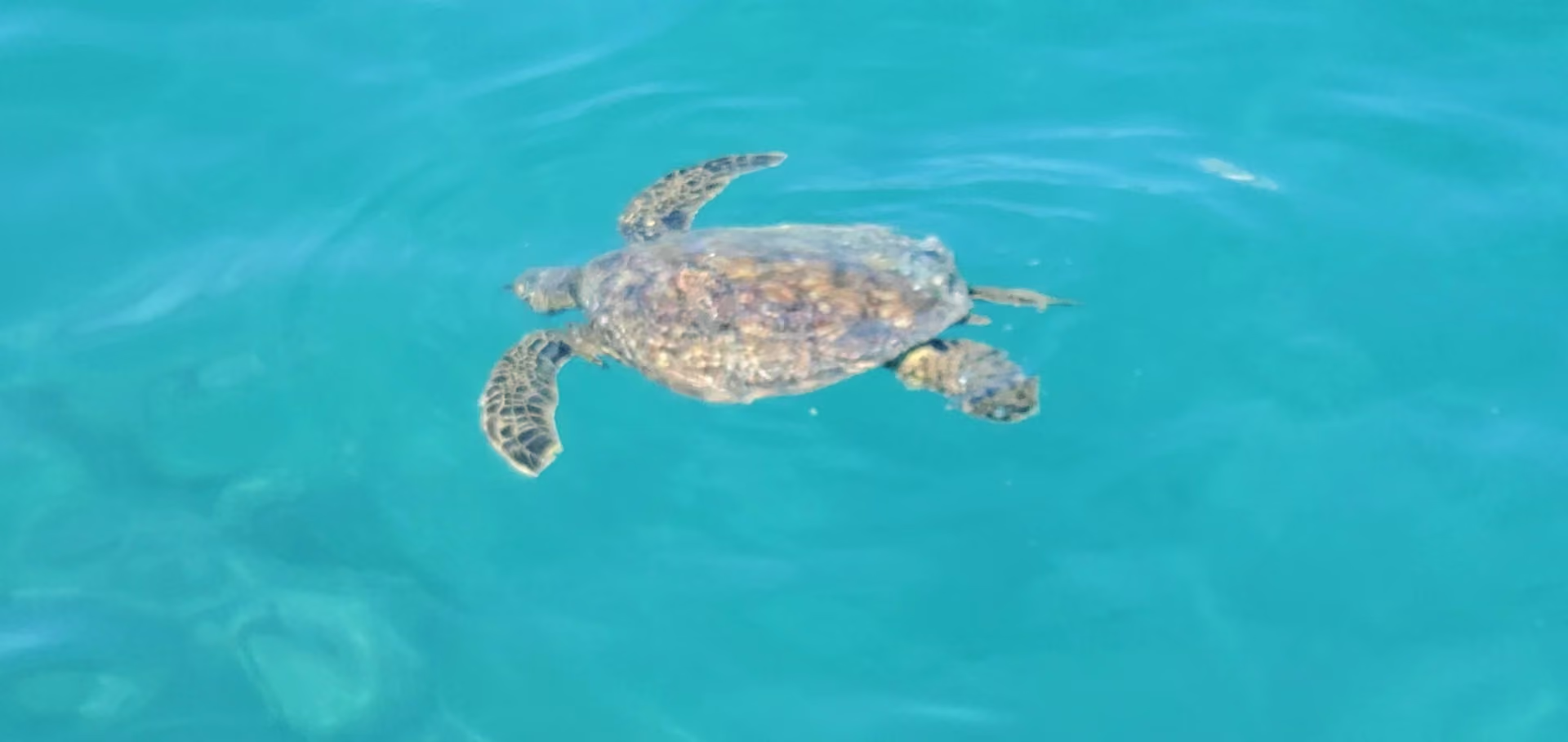
Today, visitors snorkeling near Kaʻawaloa Cove can observe colorful reef fish, yellow tangs, parrotfish, and green sea turtles (honu) in pristine, crystal-clear waters.
Frequently Asked Questions About Kealakekua Bay History
What does the name 'Kealakekua' mean in Hawaiian?
"Kealakekua" stems from the Hawaiian words ke ala ke kua, which translates directly to "the pathway of the god." The name reflects the bay's ancient spiritual status, its association with sacred royal burials, and its connection to ceremonies honoring the deity Lono during the Makahiki festival.
How did Captain James Cook die at Kealakekua Bay?
Captain Cook was killed on February 14, 1779, during a beach confrontation at Kaʻawaloa. After a British jolly boat was taken for its iron, Cook landed with armed marines and tried to hold High Chief Kalaniʻōpuʻu hostage aboard his ship until the boat was returned. Tensions exploded on the shoreline when news spread that another chief had been killed across the bay, leading to a quick skirmish where Cook and several others lost their lives.
Can you drive directly to the Captain Cook Monument?
No, you cannot drive to the Captain Cook Monument. The monument sits in a protected roadless zone on the north shore of the bay. Visitors can reach it by hiking down the steep Kaʻawaloa trail, paddling across the water with a permitted kayak operator, or joining a guided boat tour.
Honoring Kealakekua Bay's Legacy
Understanding Kealakekua Bay history adds a deep layer of appreciation when looking out across its calm, blue waters. From ancient ceremonial heiau platforms and royal burial grounds to early European contact and modern marine conservation, these waters tell a rich story.
As a woman- and veteran-owned operator based right out of Keauhou Bay, Dolphin Discoveries is dedicated to respectful ocean stewardship. We guide small groups on naturalist-led fast boat tours that focus on ethical wildlife interactions and reef-safe practices. If you would like to explore these historic waters with us, consider booking a small-group Captain Cook snorkel tour or exploring our other ocean adventures along the Kona coast.